%20(1).avif)
%202.jpg)
So, what is data-driven marketing? Simply put, it's the strategy of using customer data—like their behaviors, preferences, and past interactions—to make smarter, more informed marketing decisions. It's about moving from guesswork to certainty.
Think of it this way: instead of launching a campaign based on a hunch, you use real evidence to understand what your audience truly wants. Data allows you to "listen" to your customers, so you can stop guessing and start creating campaigns that resonate on a personal level.
From Guesswork to Growth: The Data-Driven Shift
For a long time, marketing relied heavily on intuition. Campaigns were created based on a gut feeling about what might work, and success was often hard to measure. Data-driven marketing completely flips that script by prioritizing hard evidence over hunches.
Instead of just hoping an ad connects with people, you look at past performance data to see what actually works. It turns marketing from an art of assumptions into a science of results. A key part of this is understanding what a business intelligence dashboard is, as these tools turn raw numbers into clear, actionable insights.
This modern approach helps you create campaigns that are more personal, efficient, and—most importantly—more effective.
When businesses use the data they already have, they can completely change how they connect with customers. This knowledge gives marketers the confidence to make better decisions and fine-tune their strategies for real impact.
Traditional vs. Data-Driven Marketing at a Glance
To see the difference clearly, here's a quick comparison of the old way versus the new.
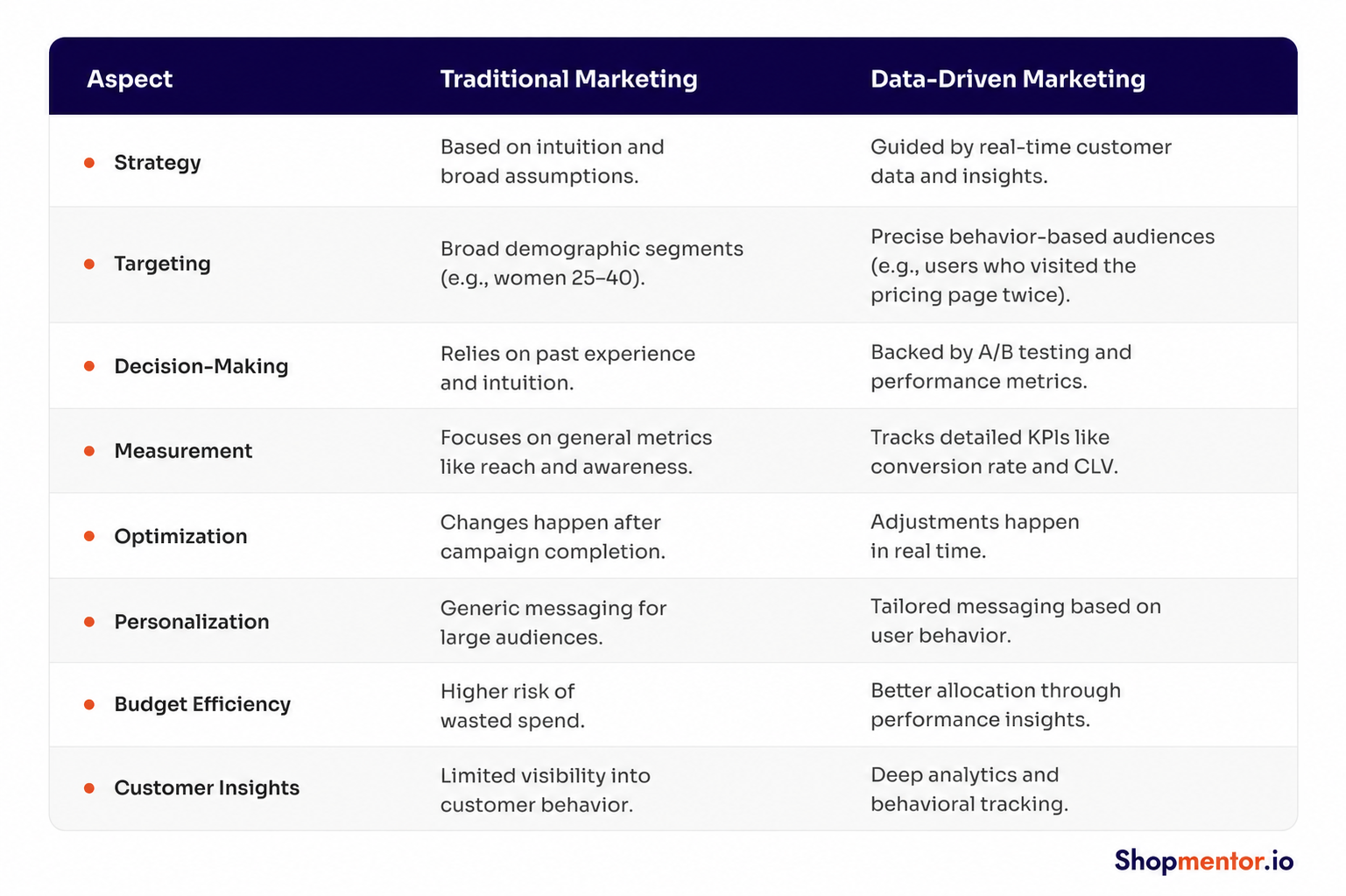
It's a fundamental shift from broadcasting a generic message to having an informed, personalized conversation. This switch gives you some serious advantages:
- Deeper Customer Understanding: You get a crystal-clear picture of what your customers do and what they want.
- Improved ROI: Your budget goes directly into the channels and tactics that you know are working.
- Better Decision-Making: Every choice you make is backed by cold, hard facts.
The Pillars of a Data-Driven Strategy
To get data-driven marketing right, you need a solid foundation built on four key pillars. Think of it like building a house—you can't just throw up walls wherever you feel like it. You need a logical process to create something that stands strong.
This process is all about turning raw information into a genuine competitive advantage. It's the difference between just having a pile of data and actually using it to fuel real business growth.
The Four Core Pillars
A successful strategy depends on four components that work together in a continuous cycle:
- Data Collection: This is where you gather your raw materials. It involves pulling information from every customer touchpoint—website traffic, social media engagement, email campaign results, and CRM data are all prime sources.
- Data Analysis: Now that you have the materials, you need to figure out what they mean. Analysis is about sifting through that data with the right tools to spot patterns, trends, and clues about customer behavior.
- Actionable Insights: This is the "so what?" moment. A pile of analyzed data is useless until you turn it into a clear, strategic conclusion. This is where you figure out what the data is telling you to do next.
- Strategy Implementation: Finally, it's time to act. This is where you put your insights to work by launching new marketing campaigns, tweaking your website, or creating content based directly on what you've learned.
This visual shows how these pillars feed into each other to drive better business outcomes.
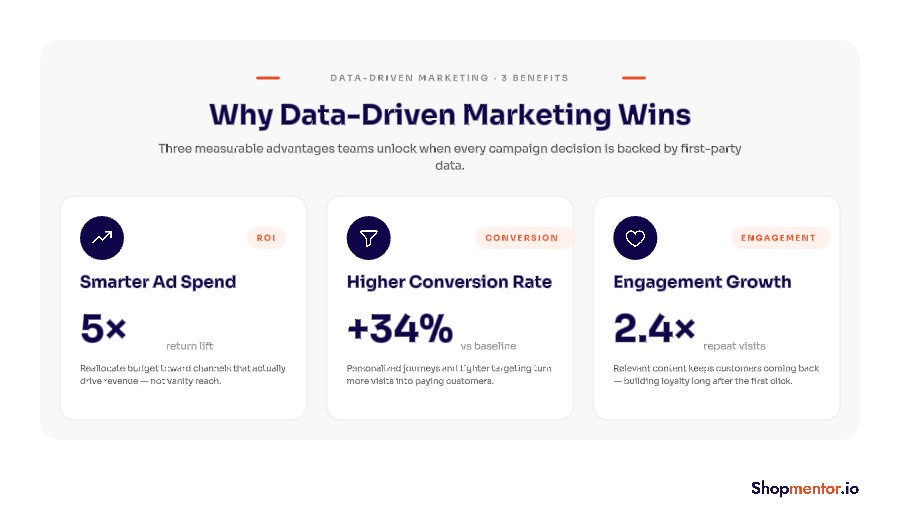
As you can see, a structured approach directly connects your marketing efforts to tangible results like improved ROI, higher conversion rates, and much better customer engagement.
The Big Shift to First-Party Data
The way we approach this is constantly evolving, thanks to shifts in consumer behavior and new privacy rules. In fact, a staggering 64% of marketing executives agree that data-driven marketing will be critical for success by 2026.
With browsers phasing out third-party cookies and regulations like GDPR getting stricter, the spotlight has swung firmly onto first-party data. This is the information you collect directly from your own audience, making it more important than ever to unify and use your own customer data.
A fundamental pillar of any effective data-driven strategy is the ability to effectively analyze customer feedback.
Turning customer comments from surveys and reviews into usable data is a game-changer. A helpful guide to analyzing customer feedback can walk you through how to structure this process, ensuring you don't miss out on valuable insights.
How Data-Driven Marketing Boosts Business Growth
Let's move past the theory. Adopting a data-driven marketing mindset is all about getting tangible results that show up on your bottom line. It’s about making smarter, more efficient choices that lead to real growth.
One of the biggest wins is deep personalization. Instead of blasting the same generic message to your entire email list, you can use data to craft offers and content that speak directly to an individual's needs. When customers feel understood, they become loyal.
Higher Marketing ROI and Better Decisions
Ultimately, this all funnels down to a much higher return on your marketing investment (ROI). Once you understand which channels and campaigns are actually bringing in customers, you can stop wasting money on tactics that don’t work and double down on what does.
- Improved Customer Experience: Data helps you create a seamless journey for your customers, with personalized content and relevant follow-up emails.
- Confident Decision-Making: With solid evidence backing your choices, your team can stop guessing and replace assumptions with clear, data-backed direction.
“When you start looking at performance data, you learn which marketing efforts are truly moving the needle. It empowers you to refine your approach, cut out inefficiencies, and focus your energy where it will have the greatest effect on business growth.”
This shift isn't just a trend; it's accelerating globally, thanks to better analytics and AI. Companies using a data-driven approach are already seeing revenue increases of 5-15% and boosting marketing efficiency by 10-30%.
Making these benefits a reality starts with the right foundation. Implementing smart small business online marketing strategies gives you the perfect base to layer a data-driven approach on top.
How AI Is Supercharging Data-Driven Marketing
If data is the new oil, then artificial intelligence (AI) is the engine that turns it into rocket fuel for your marketing. AI can process massive datasets at a speed humans can't match, transforming raw information into tangible growth.

This isn't just a trend; it's a massive economic shift. The AI marketing industry is on track to be worth over $107.5 billion by 2028. These numbers scream one thing: businesses are betting big on AI’s ability to analyze data, spot trends, and create personal customer experiences.
Ultimately, this technology helps marketers move from a reactive headspace to proactively anticipating what customers will want next. It’s all about getting ahead of the curve.
Practical AI Marketing Applications
So, what does this actually look like? AI is a set of practical tools that can give any business a serious competitive edge.
Here are a few ways AI is already making a huge impact:
- Predictive Analytics: AI sifts through past actions to make accurate forecasts about what your customers are likely to do next, from which products they'll buy to when they might be at risk of churning.
- Generative AI: Instead of writing one generic message, you can use AI to instantly generate hundreds of unique versions of emails, social media posts, and ad copy tailored to specific audience segments.
- Marketing Automation: AI takes basic automation and puts it on steroids. It can optimize campaigns in real-time by automatically adjusting ad bids, sending follow-up messages at the perfect moment, and streamlining workflows.
By integrating AI, marketers can do more than just understand past customer behavior—they can actively shape future outcomes. This proactive approach is what truly separates the leading businesses from everyone else.
Of course, having these tools is one thing; using them effectively is another. Our guide on AI-powered SEO strategies for local businesses breaks down actionable steps to start putting these powerful technologies to work for you.
Implementing Your First Data-Driven Campaign
Jumping into data-driven marketing might feel like a massive project, but your first campaign is more straightforward than you’d think. The secret isn't trying to do everything at once; it's about starting with a clear, simple framework.
First, set a specific, measurable goal. What does a "win" look like? Maybe it’s boosting website sign-ups by 15%. A clear objective becomes your North Star, keeping every decision on track.
Setting Your Foundation for Success
With a goal in hand, figure out where your data lives. Most businesses have treasure troves of information in Google Analytics, a customer relationship management (CRM) system, social media insights, and even point-of-sale software.
The trick is to pull these threads together. When you can see everything in one place, you get a complete picture of your customer, and that’s when patterns—and opportunities—start to emerge.
Next, pick your tools. You don't need to break the bank. Powerful and free tools like Google Analytics can give you a phenomenal amount of information about your website visitors.
Starting small is the secret to long-term success. A pilot project focused on one clear goal allows you to test your approach, learn from the results, and prove the value of data-driven decisions before scaling up.
Building Skills and Taking Action
Finally, this is about building skills and a culture of curiosity. Get your team comfortable with asking questions and digging into data to find answers. On a practical level, knowing how to track events is a game-changer, as it lets you gather specific user actions.
From there, launch a small pilot campaign. See what works and what doesn’t, then pour those lessons into your next attempt. This cycle of testing, learning, and refining is the real engine behind effective data-driven marketing.
Common Questions About Data-Driven Marketing
Jumping into a data-driven strategy can feel overwhelming and often brings up a few common questions. Let's tackle them head-on, because the answers are probably simpler than you think.
One of the biggest concerns is about the sheer volume of information. "How much data do I really need to get started?" The best advice is always the same: start with what you have. Even basic insights from Google Analytics or social media profiles are enough to build a solid foundation.
Can I Get Started on a Budget?
The next question that almost always comes up is about cost. "Is a data-driven strategy too expensive for my small business?" Absolutely not. While advanced platforms can be expensive, many of the most powerful tools for beginners are free or very low-cost.
- Google Analytics: This is non-negotiable for understanding your website traffic and visitor behavior.
- Social Media Insights: Every platform, from Facebook to Instagram, gives you detailed breakdowns of your audience demographics and top-performing content.
- Email Marketing Platforms: Services like Mailchimp have built-in analytics that show you who is opening your emails and clicking your links.
The secret isn't having the most expensive software; it's about consistently using the data you can already access. And don't forget, managing your digital presence is part of this too. Our guide on online reputation management for small business offers more ways to complement a data-first mindset.
The goal isn't to analyze everything at once. It's about starting with a single, clear question—like "Where do my best customers come from?"—and using the data you have to find a reliable answer.
This approach builds momentum. It shows you the real-world value of data-driven marketing without requiring a massive investment in fancy systems or specialized teams right out of the gate.
Ready to turn your business data into your greatest asset? Shopmentor.io connects all your marketing channels—from Google to social media—into one simple dashboard, giving you clear, AI-powered recommendations to boost your visibility and attract more customers. Start your free trial and see the difference data can make.