%20(1).avif)
%202.jpg)
Effective reputation management for small businesses is the modern version of word-of-mouth marketing, only now it happens at scale across Google, social media, review platforms, and search results. Every review, comment, and online interaction shapes how potential customers perceive your business before they ever contact you.
Today, your digital reputation is often your first impression. Before customers visit your storefront, schedule an appointment, or request a quote, they search online to evaluate your credibility. What they find directly impacts whether they choose your business or move on to a competitor.
That’s why online reputation management for small business owners has become one of the most important parts of modern digital marketing.
A strong online reputation helps:
- Build trust instantly
- Increase local search visibility
- Generate more leads and conversions
- Improve customer retention
- Strengthen long-term brand credibility
A weak or neglected reputation, however, can quietly cost your business customers every single day.
Why Online Reputation Management Matters for Small Businesses
For small businesses, reputation isn’t just about perception. It directly affects revenue.
Research consistently shows that customers rely heavily on reviews before making purchasing decisions. Businesses with strong ratings and active customer engagement typically outperform competitors in both visibility and conversion rates.
The connection between reputation and growth is clear:
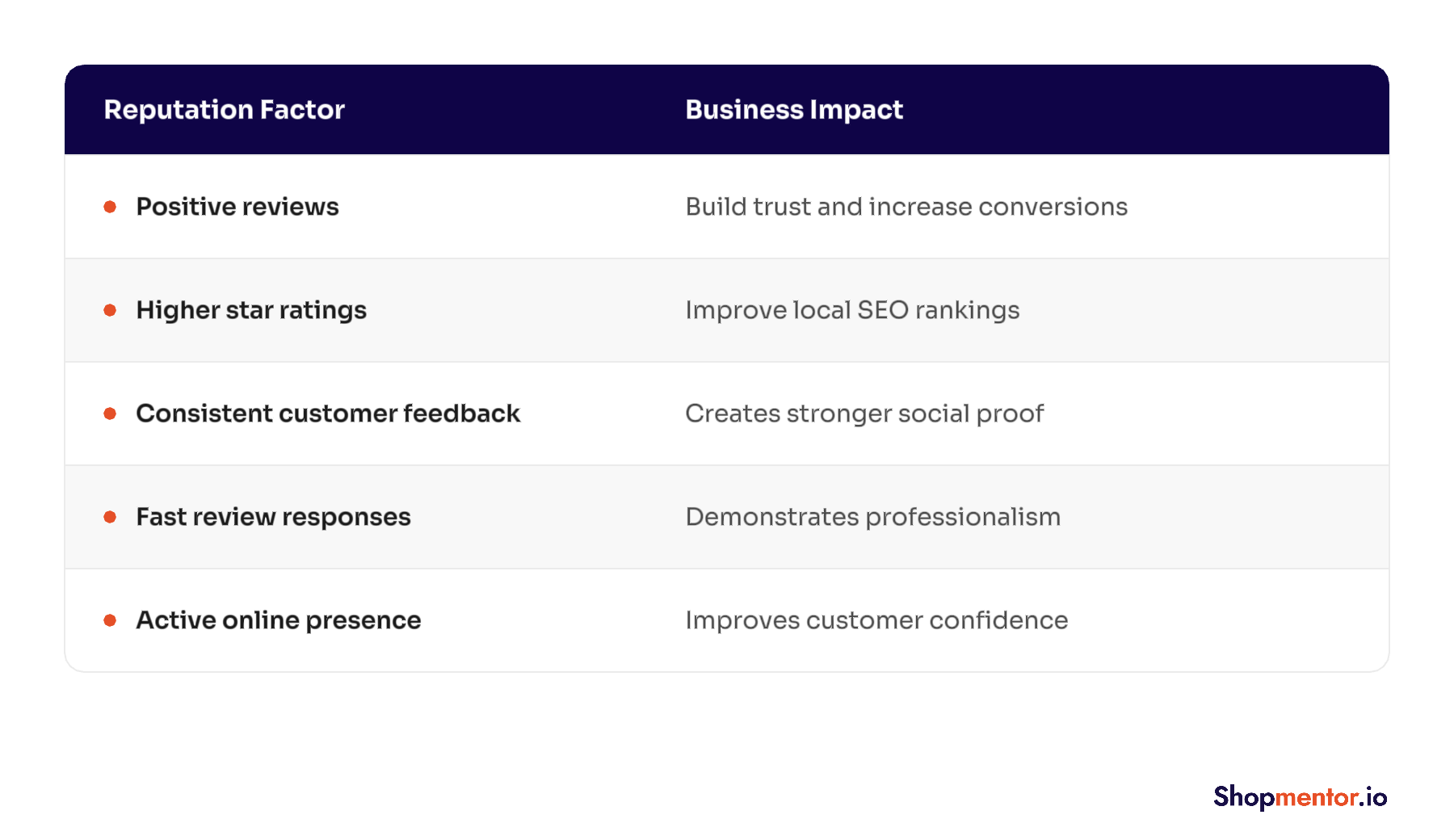
Businesses with strong reputations are easier to trust, easier to find online, and more likely to attract repeat customers.
What Is Small Business Reputation Management?
Small business reputation management is the process of monitoring, influencing, and improving how your business appears online.
This includes:
- Managing customer reviews
- Monitoring brand mentions
- Responding to feedback
- Improving search visibility
- Encouraging positive customer experiences
- Addressing negative reviews professionally
- Building a trustworthy online presence
In simple terms, business online reputation management ensures that when customers search for your business online, they find accurate information, positive experiences, and a brand they feel confident choosing.
Your Online Reputation Is Your Digital Storefront
For many customers, your online presence is your storefront before they ever interact with your business directly.
They’re evaluating:
- Your Google reviews
- Your social media activity
- Your website quality
- Your customer interactions
- Your overall online credibility
This is especially important for local businesses competing in crowded markets. If two companies offer similar services, customers almost always choose the one with:
- Better reviews
- Higher ratings
- More recent customer feedback
- Stronger online engagement
That’s why online reputation management for small businesses is no longer optional. It’s essential.
Building a Strong Digital Foundation
A strong reputation starts with building trustworthy and consistent online profiles.
Before customers leave reviews or engage with your business, they need to find accurate, professional information online.
Optimize Your Google Business Profile
Your Google Business Profile is one of your most valuable online assets.
A fully optimized profile should include:
- Accurate business name
- Correct address and phone number
- Updated hours
- Services and products
- High-quality photos
- Website link
- Business description
Businesses with optimized Google profiles often receive:
- More calls
- More website clicks
- More map visibility
- Higher local search rankings
For local businesses especially, this is the foundation of effective reputation management for small businesses.
Maintain Consistent Business Information
Your business information should remain consistent across every online platform.
This includes:
- Business name
- Address
- Phone number
- Website URL
Inconsistent information confuses both customers and search engines, which can hurt local SEO performance and reduce trust.
Consistency strengthens credibility.
How to Generate More Positive Reviews
One of the biggest mistakes small businesses make is waiting for reviews to happen naturally.
Most happy customers simply won’t leave reviews unless they’re asked.
The key is creating a simple process that encourages feedback at the right moment.
Ask at the Right Time
The best time to request a review is immediately after a positive experience.
Examples include:
- After completing a service
- After receiving positive feedback
- Following a successful purchase
- After solving a customer issue
Timing matters because customer satisfaction is highest in that moment.
Make the Process Easy
The easier it is to leave a review, the more likely customers are to complete it.
Best practices include:
- Sending direct review links
- Using QR codes
- Following up via email or text
- Keeping requests short and friendly
Even small improvements in convenience can dramatically increase review volume.
Never Buy Fake Reviews
Authenticity matters. Fake reviews may violate platform guidelines and damage customer trust if discovered. Genuine customer feedback is always more valuable than artificially inflated ratings. Long-term trust always wins.
Why Reviews Matter for Local SEO
Reviews influence far more than customer perception.
They also affect:
- Google Maps visibility
- Local pack rankings
- Click-through rates
- Search engine trust signals
Businesses with strong review profiles are often rewarded with higher visibility in local search results. This makes small business online reputation management closely connected to local SEO success.
How to Respond to Reviews Professionally
Every review is an opportunity to strengthen your reputation publicly.
Your responses demonstrate:
- Professionalism
- Accountability
- Customer care
- Brand personality
Responding to Positive Reviews
Positive reviews deserve thoughtful responses.
Instead of generic replies, personalize your response by:
- Mentioning the customer’s experience
- Thanking them specifically
- Reinforcing your brand values
- Inviting them back
Example:
“We’re so glad you enjoyed your experience with us. Thank you for the kind words and for supporting our business. We look forward to seeing you again soon.”
Simple responses help strengthen customer loyalty while showing future customers that you value feedback.
Responding to Negative Reviews
Negative reviews are inevitable.
What matters most is how your business responds.
A professional response should:
- Acknowledge the issue
- Remain calm and respectful
- Show empathy
- Offer to resolve the issue privately
- Avoid defensive language
Example:
“We’re sorry your experience didn’t meet expectations. We appreciate your feedback and would like the opportunity to make this right. Please contact us directly so we can resolve the issue.”
Handled correctly, negative reviews can actually increase trust by showing accountability and professionalism.
Monitoring Your Brand Online
You can’t manage conversations you don’t know are happening.
That’s why monitoring online mentions is a critical part of online reputation management for small business growth.
Businesses should actively monitor:
- Google reviews
- Yelp
- Industry-specific review sites
- Social media mentions
- Community forums
This helps businesses:
- Respond quickly
- Address concerns early
- Identify recurring customer issues
- Improve customer experience
Common Reputation Challenges Small Businesses Face
Most small businesses struggle with inconsistent reviews, limited review volume, negative feedback, lack of dedicated time to reply to reviews, all while managing multiple platforms. As businesses grow, manually managing online reputation becomes increasingly difficult. This is why many businesses eventually invest in online reputation management services for small business growth and scalability.
Online Reputation Management Services for Small Business Owners
Professional reputation management services help businesses streamline and automate many aspects of reputation building.
Services may include:
- Review monitoring
- Automated review requests
- Local SEO optimization
- Brand monitoring
- Listing management
- Customer sentiment analysis
- Reporting dashboards
- Crisis management
For busy business owners, these services can save time while improving consistency and visibility online.
Turning Customer Feedback Into a Competitive Advantage
The best businesses use reviews as more than just feedback. They use them as marketing assets.
Positive reviews can be repurposed across:
- Websites
- Landing pages
- Social media
- Email campaigns
- Sales materials
Customer testimonials create authentic social proof that helps increase trust and conversions. At the same time, negative feedback provides valuable insight into where improvements are needed. Strong businesses listen, adapt, and improve.
Signs Your Business Needs Reputation Management
Your business may benefit from reputation management services if:
- You rarely receive reviews
- Negative reviews go unanswered
- Your competitors have stronger ratings
- Your local visibility is declining
- Customers mention inconsistent information online
- You struggle to monitor multiple review platforms
Ignoring online reputation issues usually allows them to grow over time. A proactive strategy is always more effective than reactive damage control.
The Future of Reputation Management for Small Businesses
As digital competition continues to increase, online reputation will play an even larger role in customer decision-making.
Consumers increasingly expect:
- Fast responses
- Transparency
- Authentic engagement
- Strong social proof
- Consistent customer experiences
Businesses that invest in their reputation today position themselves for stronger long-term growth, customer loyalty, and local visibility.
Final Thoughts
Small business reputation management is one of the most valuable investments a company can make in its long-term success.
Your online reputation influences:
- Customer trust
- Search visibility
- Conversion rates
- Brand authority
- Revenue growth
By actively managing reviews, improving customer experiences, optimizing local SEO, and maintaining a strong online presence, businesses can build lasting credibility in increasingly competitive markets. Whether you manage reputation internally or use online reputation management services for small business growth, the key is consistency, responsiveness, and authenticity. Because in today’s digital landscape, your reputation often becomes your most powerful marketing asset.