%20(1).avif)

Learning how to respond to negative Google reviews is more than just damage control; it's a public demonstration of your customer service. Your response shows everyone—especially potential customers—that you listen, care, and take accountability. When done right, it can transform a negative comment into a powerful tool for building trust.
Why Responding to Negative Reviews Is Non-Negotiable
Ignoring a bad review is a critical mistake. To both the unhappy customer and prospective buyers, silence screams that you don't care. In a world where online feedback heavily influences purchasing decisions, failing to respond can damage your brand's credibility.
The Silent Audience Is Watching
Every response you write is for a much larger audience than just the original reviewer. Future customers are researching your business, and they pay close attention to how you handle criticism. A thoughtful, professional reply demonstrates transparency and a commitment to customer satisfaction.
Conversely, a defensive reply—or no reply at all—can validate negative feedback and send prospects straight to your competition. Think of it as a live performance that puts your company's values on display. This is a core component of effective online reputation management for small business owners.
Responding to reviews isn't just about fixing one problem; it's about showing every future customer how you'll treat them if something goes wrong.
The Impact on Your Bottom Line and Local SEO
The data speaks for itself. Responding promptly is crucial, as 97% of people who read reviews also read the business's responses, according to Brightlocal. Consumers aren't patient, either—53% expect a reply within one week. Since Google dominates online reviews, your activity on the platform matters immensely.
This engagement directly influences your visibility in local search results. Google's algorithm rewards businesses that are active and responsive.
- Improved Local SEO: Google views your responses as a signal of an active, reputable business, which can boost your local search rankings.
- Increased Trust: A well-crafted response can turn a skeptic into a loyal customer simply by showing professionalism and care.
- Valuable Business Insights: Negative feedback often contains unfiltered truths about your operations. It’s free intelligence on where you need to improve.
The A.C.T. Framework: Your Blueprint for a Perfect Response
Knowing you need to reply is the first step, but knowing what to say is the real challenge. The A.C.T. Framework provides a reliable, three-part structure for tackling feedback professionally and constructively.
The framework is an acronym for Acknowledge, Connect, and Take Action. It serves as a playbook for moving past an emotional reaction and into a strategic, empathetic response. Following these steps helps you address the customer’s concerns, humanize your business, and show a clear path forward.
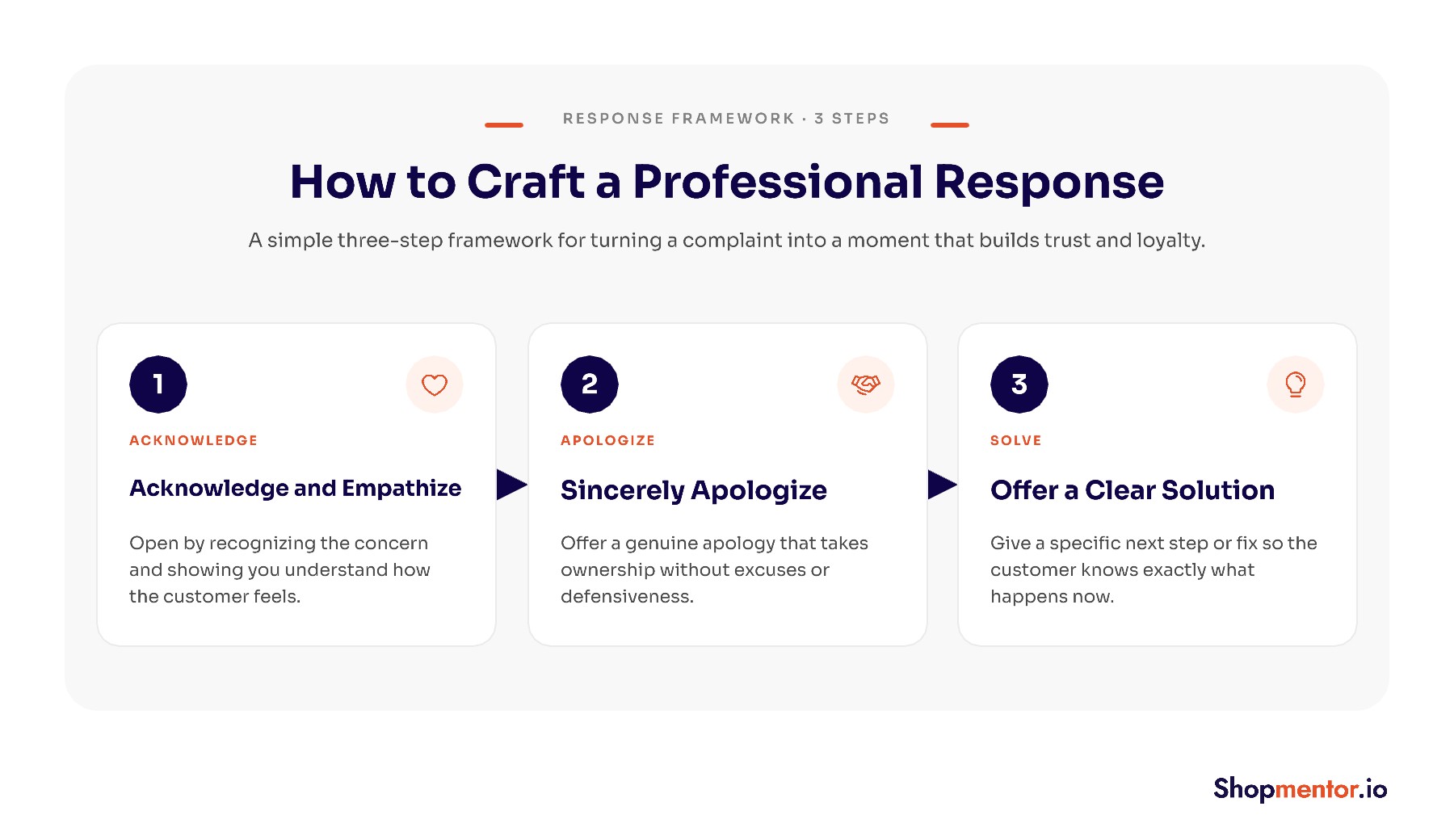
As you can see, a great response always starts with validating the customer's feelings before offering a solution.
Step 1: Acknowledge The Customer's Experience
First, Acknowledge. This step is all about validation. Before you explain or solve anything, you must show the reviewer that you’ve heard them. This simple act immediately de-escalates tension and proves you take their feedback seriously.
Start by thanking them for bringing the issue to your attention, even if their tone is harsh. You're not admitting fault; you're appreciating the opportunity to improve.
A few solid opening lines:
- "Thank you for taking the time to share your experience with us."
- "We really appreciate you bringing this to our attention."
- "We're so sorry to hear that your experience didn't live up to your expectations."
This small gesture is surprisingly powerful, shifting the dynamic from a public confrontation to a constructive conversation.
Step 2: Connect With Genuine Empathy
Next, Connect on a human level. This is where you move from a generic, corporate-sounding reply to a personal, empathetic message. Using the reviewer’s name is a small but crucial detail that shows you see them as a person, not just a complaint ticket.
Express genuine regret for what happened. An apology isn't always an admission of guilt—it can be an expression of sorrow that they left your business unhappy.
A sincere apology can transform a public complaint into a powerful demonstration of your company's character and commitment to doing right by your customers.
The goal here is to show that there are real, caring people behind your business name. This step separates a robotic, copy-paste reply from one that feels authentic and builds trust with everyone reading it.
Step 3: Take Action And Provide a Solution
Finally, it’s time to Take Action. An apology without a solution feels empty. This last step is where you outline the concrete steps you’re taking to fix the problem, showing you’re committed to making things right.
This is your chance to clarify how you'll resolve the issue. Always aim to move the specific details of the conversation offline. This protects the customer's privacy and prevents a public back-and-forth.
Provide clear contact information and next steps:
- Offer a direct line: "Please email our manager, Sarah, at sarah@email.com or call us at (555) 123-4567 so we can learn more and resolve this for you."
- Explain what you’re changing: "We are reviewing our checkout process with the team based on your feedback to ensure this doesn't happen again."
This approach demonstrates accountability. While only about 5% of businesses regularly respond to their online reviews, 44.6% of consumers say they are more likely to visit a business that does. Understanding the broader principles of mastering effective customer service responses can further enhance the power of the A.C.T. Framework.
A.C.T. Response Framework: Quick Reference
To make this easier to apply, here’s a quick-reference that breaks down the A.C.T. framework. Keep this handy the next time you're facing a tough review.
Acknowledge
Validate the customer’s feedback and de-escalate the situation.
- “Thank you for sharing your experience.”
- “We’re sorry to hear your visit didn’t meet expectations.”
- “We appreciate you bringing this to our attention.”
Connect
Show genuine empathy and humanize your business.
- “We understand how frustrating that must have been.”
- “That is certainly not the standard of service we aim for.”
- “Hi [Customer Name], we sincerely apologize for the issue you faced.”
Take Action
Provide a clear resolution and move the conversation offline.
- “Please email our manager, [Name], at [email] so we can make this right.”
- “We are addressing this with our team immediately.”
- “We’d appreciate the chance to discuss this further. Please call us at [phone].”
How to Respond to Negative Google Reviews That Are Tricky
Sooner or later, you'll get that review—the one that feels deeply unfair, is factually incorrect, or seems to come from a place of pure rage. Handling these moments is what separates the pros from the amateurs in reputation management.
Your goal here shifts from problem-solving to de-escalation. You need to correct the record without starting a public flame war, all while protecting your business’s good name.
Dealing with Fake or Malicious Reviews
Few things are more infuriating than a one-star review from someone who was never your customer. It could be a competitor, a disgruntled ex-employee, or a complete fabrication. While your gut reaction might be to fire back, a calm, strategic response is your best move.
First, flag it. Google has a process for reporting reviews that violate its policies. It's not a magic wand and doesn't guarantee removal, but it’s a critical first step.
While waiting on Google, you should post a public reply.
- Stay professional and calm. Simply state that you have no record of their visit or purchase.
- Keep it short. A long, defensive saga can make you look guilty. A simple, direct statement is far more powerful.
- Take it offline. "We take feedback seriously but can't find any record of your visit. Please contact our manager, [Name], at [email] so we can learn more."
This approach shows legitimate customers that you’re responsive and subtly signals that the review might not be genuine—without you having to sling mud.
According to Brightlocal's user-generated review statistics, fake reviews are a significant concern for consumers, making a proper response essential.
Correcting Reviews with Factual Errors
Sometimes, a customer leaves a bad review based on a misunderstanding. They might misquote a price, get a policy wrong, or even confuse your business with another. Your job is to set the record straight without making the customer feel foolish.
Your response isn't about winning an argument. It’s about providing clarity for every future customer who reads that review.
The key is to be helpful and polite, not confrontational.
For example, imagine a customer complains that your "free delivery" wasn't free because they were charged a fee. Your policy clearly states free delivery is for orders over $50, and theirs was smaller.
A bad response: "You're wrong. Our website clearly states free delivery is for orders over $50."
A great response: "Hi [Customer Name], we're sorry for any confusion regarding our delivery fees. To clarify for you and other customers, we offer complimentary delivery on all orders over $50. We'd be happy to discuss your specific order if you could reach out to us at [contact info]."
This version gently corrects the information while remaining completely professional. It educates future readers and reinforces your commitment to transparency.
Response Templates You Can Use Right Away
Knowing the theory is one thing; having the right words ready when a 1-star review appears is another. To help you tackle how to respond to negative Google reviews effectively, here are a few adaptable templates.
Think of these as starting points. Personalize them with details from the reviewer's specific complaints to show you genuinely read and understood their issue.
For When You Genuinely Messed Up
This is for when your business dropped the ball. The customer is upset for a valid reason, and there's no room for excuses. A straightforward, honest apology is the only way forward.
Scenario: A restaurant customer complains about a cold meal and painfully slow service, mentioning a 45-minute wait for food.
The Fix:
"Hi [Customer Name], thank you for bringing this to our attention. We are so sorry to hear that your meal was not served to our standards and that your wait time was unacceptable. This is not the experience we want for any of our guests, and we sincerely apologize for failing you. We are reviewing this feedback with our kitchen and service teams to ensure this doesn't happen again. We'd appreciate the chance to make this right. Please email me directly at [Manager's Email] so we can properly apologize."
This works because it takes full ownership without making excuses. It names the specific issues and provides a direct, personal contact to take the conversation offline, showing you're serious about fixing it.
For a Misunderstanding Over Price or Policy
Sometimes a customer feels misled on pricing, a return policy, or service terms. Your job is to clarify politely without making them feel foolish.
Scenario: A hair salon client is upset about being charged for a deep conditioning treatment they thought was included with the haircut.
The Fix:
"Hi [Customer Name], thank you for your feedback. We're sorry for any confusion regarding the cost of your deep conditioning treatment. We understand how frustrating unexpected charges can be. Our goal is always to be transparent with our pricing, and we apologize if we didn't communicate this clearly during your visit. We'll use your feedback to improve how we explain our service add-ons. If you'd like to discuss this further, please call our salon manager, [Name], at [Phone Number]."
This phrasing apologizes for the confusion, not the pricing. It educates future customers about your policies while showing the original poster you value clear communication.
When a Specific Employee Gets Called Out
This one is tricky. You must validate the customer's feelings while supporting your team. Never throw an employee under the bus in a public forum.
Scenario: A retail customer complains that a specific cashier, "John," was rude and dismissive.
The Fix:
"Hi [Customer Name], thank you for taking the time to share this. We are very sorry to hear about your disappointing interaction with one of our team members. We take customer service very seriously, and the behavior you described does not meet our standards. We will be addressing this matter internally and providing additional training to our team to ensure all customers feel respected and valued. We appreciate you making us aware of this."
This response reassures the customer they've been heard and that you're taking action. It keeps the resolution internal, which tells the public you have high standards and a professional process for handling such issues.
Transforming Bad Reviews Into Business Gold
Every bad review stings, but they're also a goldmine of business intelligence. Think of learning how to respond to negative Google reviews not as damage control, but as a direct line to critical insights. Each piece of feedback is raw, unfiltered data showing you exactly where the friction is in your customer journey.
Instead of seeing each bad review as a one-off problem, treat them as a dataset. By systematically tracking complaints, you’ll quickly notice patterns that point to recurring problems in your operations, products, or service.
Finding the Patterns in the Pain
Start by creating simple categories for feedback in a basic spreadsheet.
- Product/Service Quality: "The coffee was cold" or "the haircut was uneven."
- Customer Service: "The cashier was rude" or "no one was available to help."
- Process/Operations: "The checkout process was confusing" or "my appointment started late."
- Pricing/Value: Customers felt the cost didn't match the value received.
After a few weeks, the data will speak for itself. If 70% of your negative reviews mention long wait times, you have an operational bottleneck that needs fixing. This data-driven approach removes the guesswork from improving your business.
Closing the Loop for Maximum Impact
Identifying the problem is only half the battle. The real magic happens when you "close the loop" publicly. This means mentioning the specific changes you’ve made because of customer feedback in your future review responses.
For example, after tackling a wait time issue, a future response could include:
"Hi [Customer Name], thank you for your feedback. We're sorry to hear about the delay. Based on customer feedback, we've implemented a new check-in system that has significantly reduced our wait times, and we hope you'll give us another chance to show you the improvements."
This strategy shows every potential customer that you are a business that listens, adapts, and genuinely cares. This builds immense trust and can even encourage more positive feedback. For more guidance, check out our insights on asking for a review.
Frequently Asked Questions About Negative Reviews
Navigating online feedback can be tricky. Even with a solid game plan for how to respond to negative Google reviews, certain situations require a quick, clear answer.
Here are some of the most common questions from business owners.
How Quickly Should I Respond?
You should aim to reply within 24 hours. A fast response signals to all potential customers that you are attentive and take feedback seriously. In many cases, a quick reply can stop a small issue from snowballing.
Should I Offer a Discount in a Public Response?
It's best to avoid this. Offering discounts or freebies in a public comment can set a bad precedent, potentially encouraging negative reviews just to score a freebie.
Your public response should focus on your commitment to resolving the issue, not on the specifics of compensation.
Instead, keep your message professional and centered on moving the conversation offline. A simple "We want to make this right" followed by a request to contact your team directly is far more effective.
What If a Customer Updates Their Review?
How you handle this depends on the change.
- If they change it to a positive review: This is a huge win! Add a brief, public thank you. "Thank you so much for giving us the opportunity to resolve this. We're so glad we could turn your experience around!"
- If it remains negative: Do not get into a public back-and-forth. Simply repeat your original offer to solve the problem offline. A long, drawn-out public argument will only hurt your reputation.
Is It Ever Okay to Not Respond?
Almost never. The only real exceptions are for reviews that are clearly spam, use hate speech, or are gibberish. In those cases, your time is better spent flagging the review for Google's removal. For all other legitimate feedback, a response is essential for your reputation and can even help improve local SEO.
Ready to take control of your online reputation and turn reviews into growth? Shopmentor.io is your AI-powered partner for local business success. Our platform analyzes your reviews, social media, and local rankings to give you clear, actionable steps to outshine the competition. Start your free trial today and see how easy it is to manage your online presence.