%20(1).avif)
Trying to grow a business while ignoring your competitors is like driving blindfolded. You might move forward, but you have no idea where you're headed or what obstacles are in your way. Learning how to conduct competitive analysis is a crucial step that transforms raw information into a real, actionable advantage for your business.
This guide provides a systematic process to gather intelligence, pinpoint competitor weaknesses, understand their strengths, and spot the market gaps just waiting for you to fill. Done right, analysis isn't a one-off task but a fundamental part of your ongoing strategy.
Why Competitive Analysis Is Your Strategic Advantage
At its core, competitive analysis is the process of identifying who you're up against and digging into their strategies to see how you stack up. It’s a non-negotiable practice for making smart decisions that actually lead to growth.
Imagine a local bakery that keeps seeing a long line at a nearby café. A little digging reveals the café gets constant online requests for gluten-free pastries but doesn't offer any. Boom. That's a golden opportunity for the bakery to launch a gluten-free line and instantly capture an underserved part of the local market. That's the power of this process in a nutshell.
Uncovering Hidden Opportunities
The goal here isn't to just copy your competitors; it's about figuring out what they aren't doing. When you dissect their marketing, pricing, and customer feedback, you unearth invaluable intelligence that can light up your own path forward.
A solid analysis helps you do a few key things:
- Spot Market Gaps: Find out what customer needs are being ignored.
- Sharpen Your Strategy: Make decisions on products, marketing, and pricing that are backed by data, not just gut feelings.
- See What's Coming: Identify emerging trends so you can adapt before you're forced to.
- Level Up Your Offerings: Benchmark your own products or services against the competition to find clear areas for improvement.
Businesses are taking this seriously, and the numbers prove it. The global market for competitor analysis tools was valued at $4.32 billion in 2021 and is on track to hit $6.6 billion by 2025. That kind of investment shows just how critical this has become. For a deeper dive, you can explore the full competitor analysis market report to see the trends for yourself.
Key Takeaway: Competitive analysis flips the switch from reactive to proactive. Instead of just putting out fires, you start anticipating where the next one might be, giving you a massive head start.
Another goldmine of information is your competitors' customer reviews. They tell you exactly what people love and hate, laying out their strengths and vulnerabilities in plain sight. This is a huge piece of the puzzle, something we cover in our guide on online reputation management for small business, because public feedback is a direct line into your competitive strategy.
Your Competitive Analysis Framework at a Glance
To give you a clear roadmap of where we're headed, this table breaks down the core components we'll cover in this guide. Think of it as your cheat sheet for turning data into decisive action.
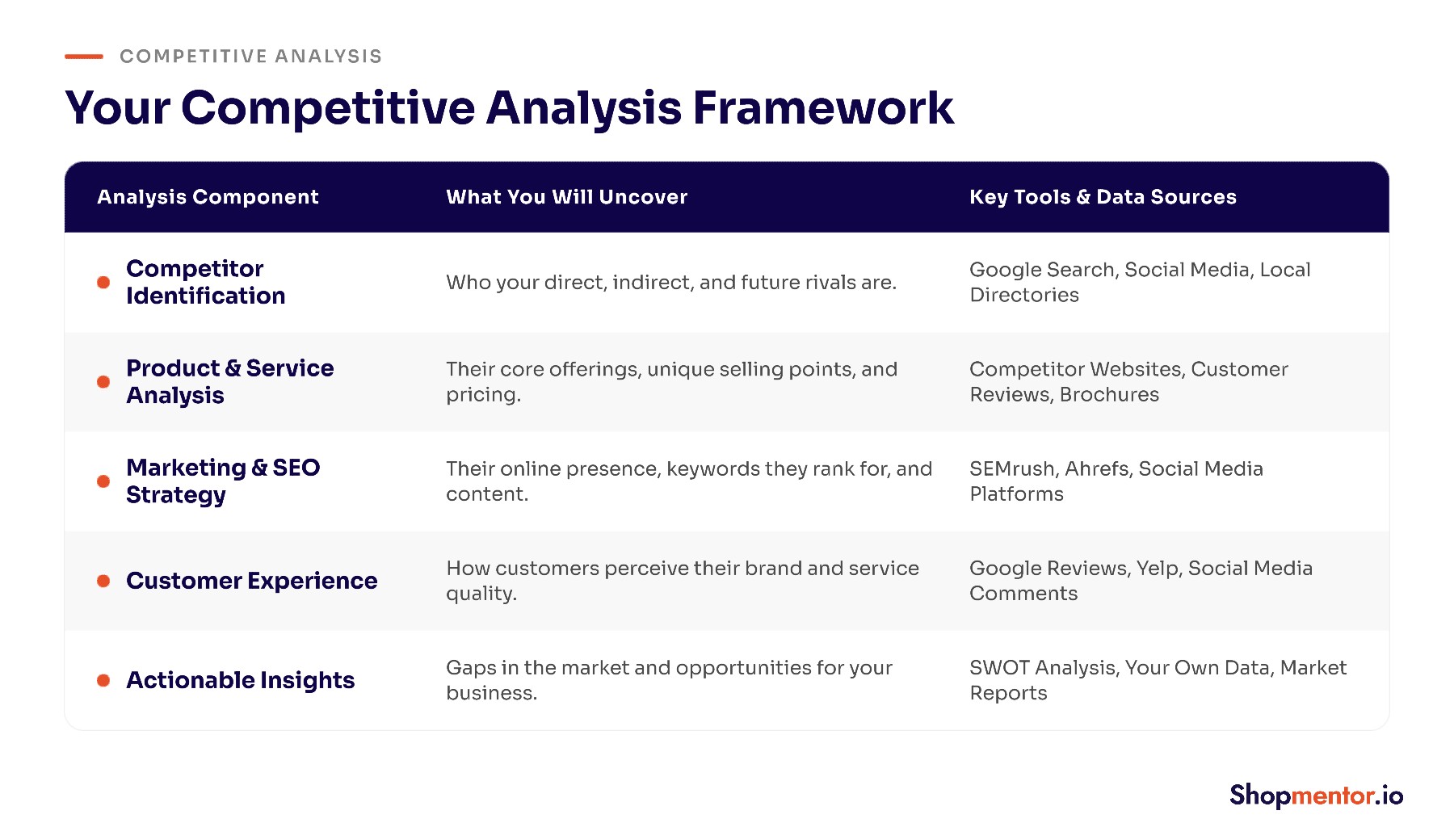
By the end of this guide, you’ll have a repeatable process for each of these areas, ensuring you’re always one step ahead.
Pinpointing Your Real Competitors
Before you can analyze the competition, you need to know who you're really up against. It's easy to get tunnel vision, only focusing on the business down the street that sells the same exact thing. In reality, your competitive landscape is almost always bigger and more complex than it first appears.
The trick is to think beyond the obvious rivals. To get a clear picture and gather the right intel, you first need to build a robust competitor analysis framework. This helps you sort rivals into key categories so you don’t miss hidden threats or untapped opportunities.
Direct Competitors
These are the ones you already know. They’re the businesses selling the same product or service to the very same audience you are.
If you run a local Italian restaurant, the other Italian joints in your neighborhood are your direct competitors. Simple. You're both fighting for the same customer, on the same night, for the same type of meal.
Indirect Competitors
Okay, this is where it gets more interesting. Indirect competitors solve the same problem for your customer, just with a different solution.
For that same Italian restaurant, an indirect competitor could be the new gourmet burger place, a meal-kit delivery service like HelloFresh, or even a high-end grocery store with an amazing deli counter. Your customer is still hungry and looking for dinner, but now they have a bunch of different ways to solve that problem. Ignoring these players means you’re missing a massive piece of the puzzle.
Tertiary Competitors
Finally, we have tertiary competitors—sometimes called replacement competitors. These businesses aren't even in your industry, but they are competing for the same slice of your customer's budget.
For example: A couple is trying to decide what to do on a Friday night. They could go to your Italian restaurant, or they could go see a movie. The products are completely unrelated, but they are absolutely competing for the same discretionary income and "night out" budget.
Understanding this full scope is what separates good strategy from great strategy. So, how do you find all these different players?
Here Are a Few Ways to Start Digging:
- Smarter Google Searches: Go beyond just typing your business name. Use queries like
"meal kit alternatives"or compare searches like"pizza restaurant near me"vs."takeout near me"to see what else Google thinks is relevant. This shows you what real customers are looking for. - Use SEO Tools: I’m a big fan of this method. Tools like Ahrefs have a “Competing Domains” report that’s pure gold. You just pop in your website URL, and it spits out a list of other sites that rank for the keywords you’re targeting. It’s an instant way to uncover online rivals you never even knew existed.
- Listen on Social Media: Keep an eye on conversations happening online. What other brands or services do your customers mention when talking about your industry? You can uncover some really unexpected indirect and tertiary competitors just by seeing what’s on your audience’s radar.
By mapping out all three types, you create a complete battle plan. This comprehensive view is the only way to build a competitive analysis that actually gets you results.
Gathering Actionable Competitor Intelligence
Once you’ve identified who you’re up against, the real fun begins. Just collecting data for the sake of it is a surefire way to get lost in spreadsheets, not find actionable insights. To really get a handle on your competitive landscape, you have to go deeper than just a quick look at their website.
It’s about dissecting their entire operation. What’s the messaging on their homepage? How smooth is their user experience (UX)? Are their calls to action compelling? You need to dig into their social media feeds, too. See how they talk to their customers and what people are saying—good or bad. Every piece of information you gather should answer a specific question you have about their strategy.
Reverse-Engineering Their Digital Game Plan
Think of your competitors as leaving a trail of digital breadcrumbs that maps out their entire online strategy. With powerful SEO tools like Semrush or Ahrefs, you can basically reverse-engineer what’s driving their success.
You can uncover some incredibly valuable intel, like:
- Top Organic Keywords: Find out which search terms are sending the most traffic their way. This is a direct look into what their audience is looking for.
- Backlink Profile: See which authoritative websites are linking to them. This can uncover partnership or PR opportunities you hadn't even considered.
- Paid Search Campaigns: Analyze the ads they’re running and the keywords they’re bidding on. It’s a direct window into their marketing budget and priorities.
If you really want to get into the weeds of paid ads, this guide on Google Ads competitor analysis is a fantastic resource.
Modern competitive analysis goes even further, tapping into real-time data from web scraping or business intelligence (BI) tools. This lets you monitor things like pricing changes or new product launches the moment they happen, giving you a dynamic view of the market.
This process of organizing your data collection is pretty straightforward once you get the hang of it.
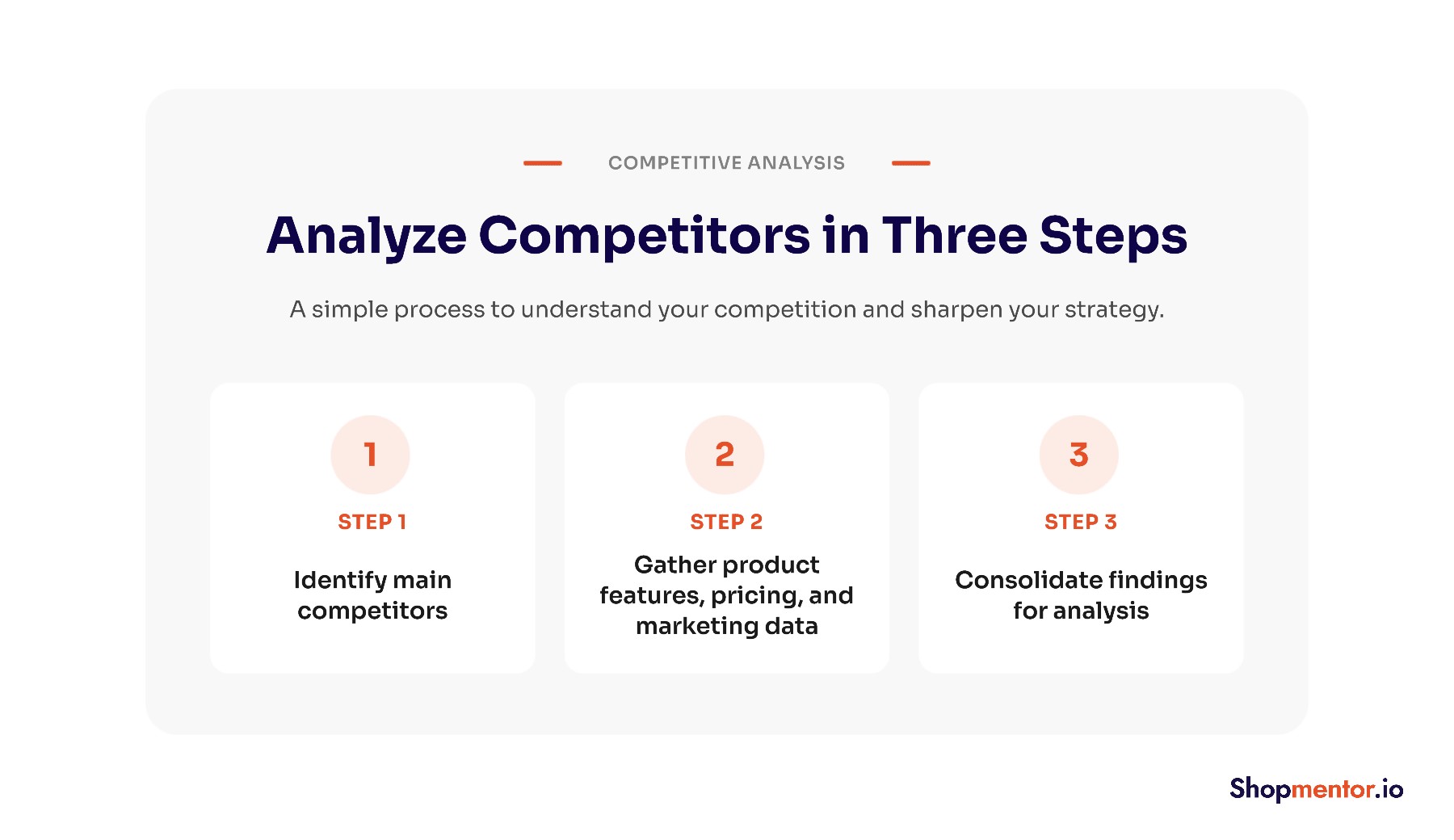
As you can see, it's a logical flow from identifying who you're up against to consolidating the data. This structured approach ensures your findings are organized and ready to be turned into a winning strategy.
Looking Beyond the Obvious Metrics
While SEO stats and ad data are gold, some of the best intelligence comes from places you might not think to look. These less conventional tactics can give you a much richer understanding of how your competitor operates.
One of the easiest—and most powerful—things you can do is simply become their customer. Sign up for their newsletter, follow them on social media, and if it makes sense, buy a product. There’s no better way to understand their sales funnel than by going through it yourself.
This hands-on approach lets you see their marketing automation, customer service, and brand voice from the inside. You’ll experience exactly how they treat leads and what their follow-up process looks like.
Here’s another clever trick: keep an eye on their job postings on sites like LinkedIn. Is a competitor suddenly hiring a bunch of video editors? They're probably gearing up for a major video content push. Are they looking for a "Head of European Sales"? That’s a massive clue about their expansion plans. These listings are often a public forecast of their next big move.
When you blend these qualitative insights with hard data, you build a complete picture of their strategy and can spot exactly where your business has an edge.
How to Conduct Competitive Analysis With SWOT
Let's be honest, raw data is just noise. A spreadsheet full of competitor keywords or a list of their prices doesn't actually tell you what to do next. The real magic happens when you translate that scattered information into a clear strategic direction.
One of the best frameworks for this is a classic for a reason: the competitor-focused SWOT analysis. It’s a simple but powerful way to organize everything you've learned into four buckets: Strengths, Weaknesses, Opportunities, and Threats.
Structuring Your SWOT Analysis
The beauty of the SWOT framework is that it forces you to stop just collecting data and start connecting it. By looking at a competitor from every angle, you can sidestep "analysis paralysis" and give every piece of information a clear purpose.
Here’s how to think about each category when sizing up another business:
- Strengths: What are they genuinely amazing at? This could be anything from incredible brand recognition and a massive email list to sky-high domain authority that’s tough to beat.
- Weaknesses: Where are the cracks in their armor? Maybe their customer service reviews are a dumpster fire, their website is painfully slow, or their flagship product is missing a key feature everyone wants.
- Opportunities: This is where it gets fun. Based on their weaknesses, where can you swoop in and win? Their terrible support is your chance to offer ridiculously good, personalized service.
- Threats: What advantages do they have that could really hurt your business? A monster marketing budget is a big one, as are exclusive deals with suppliers or a loyal customer base they've had for years.
A SWOT analysis isn't just a checklist. It's about finding direct connections. Every single weakness you spot in a competitor should immediately get you thinking about a potential opportunity for your own business.

Let’s walk through a quick example. Imagine you’re a new SaaS startup with a sleek, user-friendly project management tool. Your main competitor is an old industry giant. They have a huge marketing budget (a definite Threat), but their user interface is famously clunky and looks like it was designed in 2005 (a massive Weakness).
That single weakness creates a golden Opportunity. You can build your entire marketing message around simplicity, a beautiful user experience, and getting work done faster. Suddenly, your strategy is crystal clear: go after their frustrated customers who are fed up with a confusing system. This insight even sharpens your small business SEO strategy, because now you can target keywords related to their tool’s usability problems.
Using AI for Smarter Competitive Analysis
The future of competitive analysis is already here, and it’s running on artificial intelligence. The old way of manually digging through competitor data is painfully slow. AI tools can automate the grunt work of data collection and, more importantly, spot patterns a human might miss. This isn't about letting a robot run your business; it's about supercharging your own intuition with powerful data.
Think about it. Instead of spending days sifting through hundreds of competitor reviews, an AI tool can analyze the sentiment of thousands in just a few minutes. It can tell you, almost instantly, that customers are consistently complaining about a rival’s slow shipping or raving about one of their product features. That’s an actionable insight you can use today.
Practical AI Applications for Local Businesses
You don’t need a massive budget or a data science degree to get started. Plenty of user-friendly tools are out there that can give you a much deeper understanding of the competitive landscape. The trick is knowing where to point them to get the biggest bang for your buck.
Here are a few ways AI can completely change your competitive analysis game:
- Spotting Content Trends: AI can scan your competitors' blogs and social media to see which topics and content formats are actually getting traction in your local market.
- Sentiment Analysis: Instantly get a pulse on public perception. AI can scan reviews, social media comments, and local news articles to tell you if the buzz around a competitor is positive, negative, or just neutral.
- Uncovering Ad Strategies: Some AI platforms can effectively reverse-engineer a competitor's paid ad campaigns. You can see the exact ad copy, images, and audiences that are working for them right now.
- Predictive Analytics: This is next-level stuff. More advanced tools can even help forecast a competitor's next move by analyzing patterns in their job postings, new trademark filings, or even subtle website updates.
Key Takeaway: AI is a force multiplier. It handles the heavy lifting of data processing so you can focus on what really matters: making smarter strategic decisions for your business.
Integrating AI Into Your Workflow
Getting started with AI is a lot simpler than it sounds. Many platforms are built specifically for small business owners and have dashboards that make sense. A great first step is integrating an AI-powered competitor analysis tool with systems you already use, like your Customer Relationship Management (CRM). The efficiency gains can be huge.
The businesses that see the most success with these tools start with clear goals. They use AI to consistently monitor specific metrics that matter to them. This approach is the foundation for building smarter, more effective marketing plans.
For a closer look at how these technologies can directly boost your visibility online, check out our guide on AI-powered SEO strategies for local businesses. By embracing these tools, even the smallest local shop can gain a serious competitive edge.
Putting Your Analysis Into Action
Let's be honest: all the data in the world doesn't mean a thing if it just gathers digital dust in a folder. The real magic happens when you turn your hard-earned insights into a concrete plan that actually moves the needle for your business. This is the final, and most critical, part of learning how to conduct competitive analysis.
This is where you shift from theory to practice. You've done the work to identify market gaps and your competitors' weak spots. Now it’s time to decide which opportunities you’re going to chase first and where to put your time and money.
From Insights to Initiatives
First things first, you need to prioritize. You can't tackle everything at once, so it's crucial to rank your findings based on their potential impact versus the effort required to get them done. I'm a big fan of the simple impact-effort matrix—it's a fantastic tool for spotting the quick wins while also mapping out those bigger, long-term strategic projects.
For example, maybe your analysis showed that your biggest competitor has notoriously bad customer service. A quick win? Launch a social media campaign that puts your amazing, personalized support front and center. A longer-term play could be to develop a killer customer loyalty program that they simply can't copy.
If you want a structured way to keep this process on track, grabbing a solid competitive analysis framework blueprint can help you systematically turn those insights into action.
Getting Your Team on Board
Once you have your prioritized list, you need to get your team fired up about it. The key is to present your findings as a compelling story, not just a pile of spreadsheets. You have to explain the "why" behind your recommendations.
A powerful way to frame your analysis is by focusing on customer pain points. Instead of saying, "Competitor X is missing this feature," try this: "Customers in our market are really frustrated by X, and we are perfectly positioned to solve that problem for them."
This customer-first approach makes the data relatable. It turns your analysis from a dry report into a persuasive argument for change and clearly shows how you'll gain an edge.
Keeping Your Intel Fresh with Continuous Monitoring
The competitive landscape is constantly changing. A one-and-done analysis will be out of date before you know it. The final piece of the puzzle is creating a system to continuously monitor the competition so your intelligence stays fresh.
This doesn't have to be complicated. Set up a simple process to track key competitor moves on an ongoing basis.
Here’s what that could look like:
- Quarterly Check-ins: A quick review of their website, pricing, and any big marketing campaigns they've launched.
- Google Alerts: Set these up for your competitors' brand names. It’s an easy way to keep an eye on news and mentions.
- Social Media Monitoring: Casually watch their social channels for new promotions, product launches, or what their customers are saying.
This ongoing vigilance is what keeps your strategy agile and informed. It allows you to adapt to market shifts and consistently stay one step ahead of everyone else, making analysis a living, breathing part of your business strategy.
Frequently Asked Questions
Even with a solid plan, questions always come up once you start digging into a competitive analysis. Let's tackle some of the most common ones I hear so you can move forward and turn those insights into a real advantage for your business.
How Often Should I Run a Competitive Analysis?
This is one of the most common questions business owners ask, and the answer depends on how deeply you want to understand your local market.
A comprehensive competitive analysis should be performed at least once per year. It's also something you should do before any major business initiative, such as launching a new service, opening another location, redesigning your website, or significantly increasing your marketing budget. Think of it as your annual strategic health check.
However, your competitors won't wait a year to make changes—and neither should you.
Quarterly Reviews
Every three months, spend time reviewing the competitive landscape. Check for:
- Pricing or service changes
- Website updates and new landing pages
- Google Business Profile improvements
- New customer reviews and ratings
- Search rankings and local visibility
- New promotions or advertising campaigns
- Changes to social media activity
These quarterly reviews help you spot trends before they become competitive disadvantages.
Ongoing Monitoring
Rather than manually checking competitors every week, it's helpful to automate the process.
Simple tools like Google Alerts can notify you when competitors are mentioned online. You can also periodically monitor their Google Business Profiles, websites, and social channels to stay aware of significant changes.
For a more comprehensive approach, Shopmentor.io offers two ways to stay informed:
- One-Time Local Brand Report — Perfect if you want a professional snapshot of your business compared to local competitors. The report analyzes your website, Google Business Profile, online reputation, SEO, social presence, and competitive positioning, then highlights the biggest opportunities for improvement.
- Growth Subscription — Businesses that want ongoing competitive intelligence can subscribe to the Shopmentor.io Growth Plan, which includes a refreshed Local Brand Report every month. As competitors change their websites, earn new reviews, improve their local SEO, or launch new marketing efforts, your monthly reports help you track those changes and identify new opportunities before they impact your business.
This two-tiered approach gives you the best of both worlds: a thorough annual strategy review combined with continuous visibility into what's happening in your local market. Instead of reacting after competitors have pulled ahead, you'll have the insights you need to stay one step ahead.
Quarterly Reviews
Every three months, spend time reviewing the competitive landscape. Check for:
- Pricing or service changes
- Website updates and new landing pages
- Google Business Profile improvements
- New customer reviews and ratings
- Search rankings and local visibility
- New promotions or advertising campaigns
- Changes to social media activity
These quarterly reviews help you spot trends before they become competitive disadvantages.
Ongoing Monitoring
Rather than manually checking competitors every week, it's helpful to automate the process.
Simple tools like Google Alerts can notify you when competitors are mentioned online. You can also periodically monitor their Google Business Profiles, websites, and social channels to stay aware of significant changes.
For a more comprehensive approach, Shopmentor.io offers two ways to stay informed:
- One-Time Local Brand Report — Perfect if you want a professional snapshot of your business compared to local competitors. The report analyzes your website, Google Business Profile, online reputation, SEO, social presence, and competitive positioning, then highlights the biggest opportunities for improvement.
- Growth Subscription — Businesses that want ongoing competitive intelligence can subscribe to the Shopmentor.io Growth Plan, which includes a refreshed Local Brand Report every month. As competitors change their websites, earn new reviews, improve their local SEO, or launch new marketing efforts, your monthly reports help you track those changes and identify new opportunities before they impact your business.
This two-tiered approach gives you the best of both worlds: a thorough annual strategy review combined with continuous visibility into what's happening in your local market. Instead of reacting after competitors have pulled ahead, you'll have the insights you need to stay one step ahead.
What Are the Biggest Mistakes to Avoid?
It's really easy to get tripped up when you're just starting out. The single biggest mistake I see is collecting a mountain of data without a clear goal. This leads to "analysis paralysis," where you're surrounded by information but have no clue what to do with it.
Another common pitfall is getting tunnel vision. It's tempting to focus only on your most obvious, direct competitors. But if you do, you could completely miss the indirect or up-and-coming businesses that could quietly disrupt your entire market.
Key Takeaway: The goal here isn't to copy what your competitors are doing. It's to find the gaps they've missed so you can create a unique strategy that makes your own business the obvious choice for customers.
Finally, don't treat this as a one-and-done project. Your market is always changing. Your analysis needs to be a living document that you revisit and update to guide your strategy over the long haul.
Can I Do a Competitive Analysis on a Small Budget?
Absolutely. You don't need an enterprise marketing budget to understand your competition.
While platforms like Semrush and Ahrefs offer powerful capabilities, there are plenty of ways to gather meaningful competitive intelligence without spending hundreds of dollars each month. Success comes from asking the right questions—not simply buying more software.
Low-Cost Ways to Research Competitors
Experience their customer journey.
Visit their website, request a quote, subscribe to their email newsletter, and follow them on social media. You'll quickly learn how they communicate, what they promote, and how they engage potential customers.
Read customer reviews.
Google Reviews, Yelp, Facebook, and industry-specific review sites provide invaluable insight into what customers love—and what consistently frustrates them. Those complaints often reveal opportunities for your own business.
Take advantage of free tools.
Resources like Google Trends, Google Alerts, Google Search, and the free version of Similarweb can help you monitor competitors, identify search trends, and stay informed without paying for premium subscriptions.
When It Makes Sense to Invest
Researching competitors manually is effective, but it also takes time. If you'd rather spend that time running your business, Shopmentor.io offers two convenient options:
- One-Time Local Brand Report — Receive a comprehensive competitive analysis without committing to a subscription. The report compares your business against local competitors across your website, Google Business Profile, online reviews, SEO, social media presence, and other key factors, then identifies your biggest opportunities for growth.
- Growth Subscription — Businesses that want continuous competitive insights can subscribe to the Shopmentor.io Growth Plan, which includes a fresh Local Brand Report every month. Instead of repeating the research yourself, you'll receive ongoing updates as competitors improve their websites, gain reviews, publish new content, or strengthen their local presence.
The key isn't spending more money—it's focusing on insights that lead to better decisions. Whether you perform the research yourself or use Shopmentor.io to automate much of the process, a focused competitive analysis with clear action items will always outperform a pile of unused data.
How Do I Analyze a Competitor Who Is Way Bigger Than Me?
Going up against an industry giant can feel like a losing battle from the start. But here's the secret: you don't compete on their terms. You can't outspend them on ads or match their scale, so don't even try. Instead, your entire analysis should focus on finding their weaknesses.
Large companies are often slow. They can overlook niche customer groups, and their service can feel impersonal. These are the cracks in their armor where your small business can shine.
Pinpoint those specific gaps. Maybe they don't offer personalized consultations, or perhaps their online booking process is a nightmare. Build your strategy around being agile, offering incredible service, and creating a better customer experience. Your size isn't a liability; it's your biggest advantage.
Ready to turn competitive insights into a winning strategy? Learn more at https://www.shopmentor.io.