%20(1).avif)
%202.jpg)
Let's cut right to it. What is search engine optimization (SEO)? It's the process of making your website more visible when people search for what you offer on search engines like Google.
Think of it this way: your website is a brand-new shop on a quiet side street. SEO is like putting up bright, clear signs on the main road, pointing everyone directly to your front door. It’s all about making sure the right people—your future customers—can find you easily and without friction.
A Simple Explanation of Search Engine Optimization
When someone hops on Google and types in "best coffee shop near me" or "emergency plumber," you want your business to pop up right at the top. SEO is the work you do behind the scenes to make that happen.
It’s not some dark art or technical wizardry designed to trick Google. It's actually the opposite. Good SEO involves creating a great experience for people and making your website the most helpful, relevant, and trustworthy answer to their questions.
This means fine-tuning different parts of your site—from the words you use to how fast it loads—so search engines can understand what you're all about and confidently recommend you to searchers.
At the end of the day, SEO connects your business with people actively looking for your solutions, right at the moment they need them most. It's about being the answer.
The Real-World Impact Of SEO
Still not convinced? The numbers speak for themselves. An incredible 93% of all online experiences start with a search engine, according to Forbes, and a massive 75% of people never even click past the first page of results. If you’re not on that first page, you’re practically invisible.
Organic search isn't just a small piece of the puzzle; it drives around 53% of all website traffic on average. That makes SEO one of the most powerful marketing channels you have. It's so vital, in fact, that the industry is expected to be worth over $86.8 billion by 2026.
Ultimately, great SEO makes your website more useful to both people and search engines. To get started on the right foot, using a super simple SEO checklist for your small business is a fantastic first step. It breaks down the foundational tasks that build visibility and earn trust.
How Search Engines Actually Discover Your Content
To really get what SEO is all about, you have to think like a search engine. Imagine Google is a massive, hyper-efficient digital librarian, and its entire job is to read, understand, and organize every single page on the internet. This librarian essentially has three core tasks: crawling, indexing, and ranking.
First, the librarian sends out an army of little helpers called spiders or crawlers. These aren't creepy-crawlies; they're automated programs that zip around the web 24/7, following links from one page to the next. It's their job to discover brand-new websites and check for updates on ones they already know about. This is the very first step—how your content even gets on the librarian's radar.
The Three-Step Process to Getting Seen
Once a crawler finds one of your pages, it doesn't just glance at it. It reads the content and adds it to a gigantic, ever-growing catalog called an index. Think of this like the librarian figuring out exactly what your new book is about and deciding which shelf to put it on so people can find it later. If your page isn't in this index, it has zero chance of showing up in search results. It’s that simple.
Finally, we get to the magic moment: ranking. When someone types a question into the search bar, Google’s complex algorithms rush to the index. They sift through billions of pages in a split second to find the most helpful, relevant, and trustworthy answers. This lightning-fast process is what determines who gets that coveted top spot.
This whole system didn't just appear out of nowhere. The idea of optimizing for search engines started back in the mid-1990s. But things really kicked into gear when Google launched in 1998 with its game-changing PageRank algorithm. For the first time, a search engine started ranking pages based not just on keywords, but on how many other credible sites were linking to them. This laid the foundation for modern SEO as we know it. You can discover more about SEO's fascinating history on opositive.io.
At its core, SEO is just the practice of making it incredibly easy for search engines to do their job on your website. It all boils down to optimizing for those three key areas:
- Crawling: You need to make sure the spiders can easily get around your site without running into broken links or other dead ends. Think of it as leaving clear, well-lit hallways for them.
- Indexing: This means clearly telling the search engine what your pages are about so they get cataloged correctly. You can't be vague.
- Ranking: Here's where you prove that your content is the absolute best answer for a specific question. You’re showing the librarian that your "book" is the most authoritative one on the shelf.
When you align your website with this process, you’re helping that digital librarian confidently hand your content to the right people every single time.
The Three Core Pillars Of Modern SEO
To really get your head around what search engine optimization is, it helps to break it down into three main parts. I like to think of them as the foundation, the walls, and the curb appeal of your business online. Nail all three, and you're on your way to building something that both Google and your customers will absolutely love.
Each pillar handles a different piece of the puzzle, but they all have to work together. Focusing on just one is like building a gorgeous house on a shaky foundation—it’s just not going to last.
On-Page vs Off-Page vs Technical SEO
To make the distinctions even clearer, here’s a quick table breaking down what each pillar is responsible for.

Seeing them side-by-side helps clarify where your efforts should be focused for different goals.
On-Page SEO: The Content You Control
This is everything that lives on your website. On-page SEO is all about tweaking your content and the code behind it to make things crystal clear for search engines and, more importantly, for the people reading it.
Some of the biggest tasks here include:
- Keyword Research: Figuring out the exact words and phrases your customers are typing into Google.
- Content Quality: Writing genuinely helpful articles, product descriptions, and pages that actually solve a problem or answer a question.
- Title Tags & Meta Descriptions: Crafting the headlines and short summaries that show up in search results and convince people to click.
- Internal Linking: Smartly connecting pages on your own site to guide visitors and search engine crawlers from one spot to the next.
This infographic really drives home how keyword research is a balancing act. You're looking for that sweet spot between what lots of people are searching for and what you can realistically compete for.
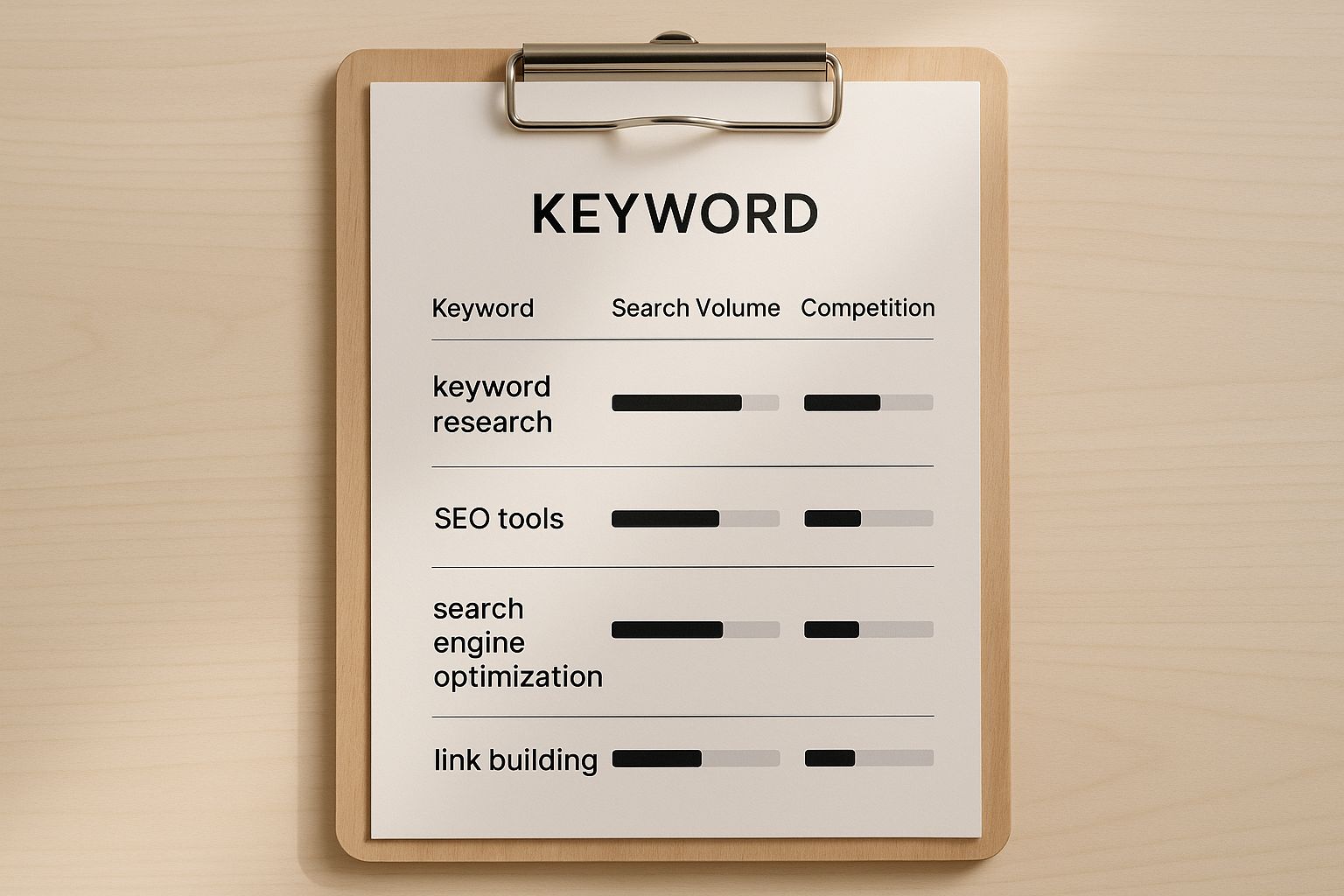
As you can see, the goal isn't just to find popular keywords, but to find the right ones that give you a fighting chance to rank.
Off-Page SEO: Building Your Reputation
If on-page SEO is what you say about your business, off-page SEO is what everyone else on the internet says about you. This pillar is all about building your site's authority and proving to search engines that you're a trustworthy source of information.
The absolute cornerstone of off-page SEO is backlink acquisition. A backlink is just a link from someone else's website pointing to yours. Think of it as a vote of confidence or a referral from a respected colleague.
To get started with off-page SEO, you first need to see who's already linking to you; learning how to find backlinks on Google is a great first step. Other important signals include brand mentions, social media buzz, and consistent business listings—something our guide on what is a local citation covers in depth.
Technical SEO: The Foundation Of Your Site
Last but certainly not least, technical SEO is the nuts and bolts. It’s all the behind-the-scenes work that ensures search engines can find, crawl, and index your website without hitting any roadblocks. Get this wrong, and even the best content might never be seen.
This covers critical factors that directly impact user experience, like:
- Site Speed: How fast your pages pop up on the screen.
- Mobile-Friendliness: Making sure your site looks and works great on a phone.
- Site Architecture: Having a logical, organized structure for your pages.
- Security (HTTPS): Using a secure connection to protect your visitors' data.
Why SEO Is A Non-Negotiable For Business Growth
Knowing what search engine optimization is is one thing, but the real question is what it can actually do for your business.
Think of it this way: your business could be the best in town, but if it's tucked away on a hidden side street with no signs, hardly anyone will ever find it. A solid SEO strategy is like picking up your shop and moving it to a prime spot in the busiest part of town, right where everyone can see you.
It's about so much more than just getting clicks. Ranking high on Google builds incredible trust and credibility. When your business shows up on the first page, customers subconsciously see you as a legitimate, authoritative leader in your field. That digital reputation is priceless for attracting savvy customers who are ready to buy.
Turning Searches Into Customers
At the end of the day, any marketing effort has to drive growth. SEO is a master at this, delivering a steady stream of high-quality leads directly to your doorstep. These aren't just random visitors; they are people actively looking for the exact products or services you offer.
A study by BrightEdge found that organic search is responsible for a whopping 53% of all website traffic. That makes it the single largest traffic source for most businesses, blowing past paid search (15%) and even social media.
This means you're connecting with potential customers at the perfect moment—when their need is at its peak. This kind of high-intent traffic naturally leads to better conversion rates and a much more predictable sales pipeline.
The Most Cost-Effective Marketing Channel
Compare SEO to paid advertising, where you have to pay for every single click, and the long-term value becomes crystal clear. While SEO does require an upfront investment of time and resources, the results compound over time. A single blog post that ranks well can continue bringing in free, targeted traffic for years to come.
This makes SEO one of the most cost-effective marketing channels out there for building sustainable growth. To start putting these benefits to work for you, check out our comprehensive small business SEO guide for actionable steps you can take today.
The Growing Influence Of AI On SEO

If there's one constant in SEO, it's change. The field is always moving, always adapting to new technology. Right now, the biggest shift we're seeing is the rise of Artificial Intelligence (AI), and it's completely changing the game for how we optimize our websites.
This isn't some far-off future concept; AI is already at the heart of how search engines work. It’s been happening for years. Think back to Google's RankBrain, which rolled out in 2015 as its first real machine-learning system for sorting out ambiguous search queries. Then came the BERT update in 2019, which gave Google a much better grasp of the natural, conversational way people actually type into the search bar.
How AI Shapes Modern SEO
So what does all this techy stuff mean for a business owner? Put simply, Google now thinks a lot more like a human. It's no longer just matching the exact keywords from a search query to a page. Instead, it’s focused on understanding search intent—the real why behind what someone is searching for.
This means our whole strategy has to evolve. Slapping keywords on a page just doesn't cut it anymore. Your new goal is to create content that directly and completely answers your customer's questions.
With AI in the driver's seat, the best SEO strategy is to create genuinely helpful content. Forget keyword stuffing. Focus on becoming the clearest, most authoritative answer to your customers' problems.
On top of that, we now have access to incredible AI-powered SEO tools that do a lot of the heavy lifting for us. These platforms can chew through mountains of data to find hidden content opportunities, keep an eye on what your competitors are doing, and even spot the next big trend before it hits. It’s like having a team of data analysts on call, 24/7.
Here are just a few things these tools can handle:
- Keyword Discovery: Unearthing long-tail keywords and entire topic clusters your competitors have completely overlooked.
- Content Creation: Helping you generate smart outlines and ideas for blog posts that are built to rank from the get-go.
- Performance Analysis: Showing you exactly what’s driving results in your current strategy and what's falling flat.
For a local business, getting comfortable with these tools is a massive advantage. We actually put together a deep dive on this very topic in our guide to AI-powered SEO strategies for local businesses. Trust me, embracing AI isn't just an option anymore—it's essential for building an SEO approach that actually works today.
Got Questions About SEO? We've Got Answers
Diving into something new always kicks up a few questions. To clear the air, we've tackled some of the most common things people ask when they're just getting started with what search engine optimization is all about.
Think of this as a quick-reference guide to firm up what you've just learned and give you the confidence to take the next step.
How Long Does It Take To See SEO Results?
This is the big one, isn't it? The honest answer is that SEO is a marathon, not a sprint. While you might see some small, encouraging wins within a few weeks, it typically takes 4 to 6 months to see significant, lasting results.
Why so long? It's because you're building real authority. The timeline depends on things like your website's age, how tough your competition is, and how consistently you work on it. The best way to look at it is as a long-term investment. It's an asset that builds momentum over time and pays you back with compounding returns.
Can I Learn And Do SEO Myself?
Absolutely! In fact, most small business owners start out by handling their own SEO, and you can make a real dent in your rankings and traffic by focusing on the fundamentals.
Start with these core tasks:
- Create Genuinely Helpful Content: Write blog posts and build out your website pages to answer the real questions your customers are asking.
- Nail the On-Page Basics: Pay attention to your page titles, headlines, and descriptions. Make them clear, descriptive, and relevant to what the page is about.
- Focus on a Good User Experience: Is your site easy to get around? Is it fast? Does it work well on a phone? These things matter more than ever.
As your business grows, you might decide to bring in an expert, but the hands-on knowledge you gain from doing it yourself is priceless.
What Is The Difference Between SEO And SEM?
This is a super common point of confusion, but it's actually pretty simple when you break it down. Just think of Search Engine Marketing (SEM) as the main event, and SEO is one of the star players.
SEM (Search Engine Marketing) is the big-picture term for everything you do to get visibility on search engines, whether you pay for it or earn it.
SEO (Search Engine Optimization) is the specific practice of earning organic (unpaid) traffic by making your site the best possible answer for search engines to show.
In other words, SEM includes both SEO (the free, long-term game) and paid strategies like pay-per-click (PPC) ads. While SEO builds lasting trust and authority, PPC can get you traffic today. Many of the most successful businesses use a mix of both.
Ready to stop guessing and start growing? Shopmentor.io uses AI to analyze your online presence and gives you clear, actionable steps to improve your SEO and attract more local customers. Start your free trial today and see how easy it can be to get noticed.