%20(1).avif)
%202.jpg)
You're not just chasing website clicks; you're trying to get real customers to walk through your front door. A local SEO audit is the roadmap that makes this happen. Think of it as a complete health check for your online presence in the specific areas you serve, making sure you show up when and where it actually counts.

Why a Local SEO Audit Is Your Secret Weapon
Let's look at a real-world scenario I see all the time. Imagine two small businesses on the same block: a beloved local coffee shop and a brand-new bakery.
The coffee shop, "The Daily Grind," has been a neighborhood staple for years, but its online presence is basically an afterthought. Its Google listing has an old phone number, the map pin is slightly off, and it has maybe a dozen reviews from five years ago.
Meanwhile, the new bakery, "Artisan Bakes," got its digital storefront in order before the ovens were even turned on. They ran a local SEO audit from day one. Their Google Business Profile is perfect—full of mouth-watering photos, accurate hours, and a complete menu. They actively ask for reviews and ensured their name, address, and phone number (NAP) are identical across every online directory that matters.
When a tourist searches "coffee near me," The Daily Grind is practically invisible. But when someone looks up "bakery downtown," Artisan Bakes completely dominates the Google Map Pack, packed with glowing reviews and easy-to-follow directions.
The bakery gets the foot traffic. The coffee shop misses out. This isn't just a case of bad luck; it's the direct result of ignoring local SEO.
Turning Clicks into Footsteps
A local SEO audit is the diagnostic tool that stops you from becoming The Daily Grind. It’s a systematic review of every signal that tells Google you’re a legitimate, relevant, and trustworthy business for a specific geographic location. Without one, you’re basically hiding in plain sight from people who are ready to buy what you sell.
The connection between online searches and real-world actions is incredibly powerful. A massive 46% of all Google searches carry local intent. That means nearly half the people on Google are looking for something nearby. Even better, a stunning 78% of mobile local searches lead to an offline purchase, often within the very same day. You can see more data on how local searches drive sales to understand the immediate, tangible return of a strong local presence.
Your local SEO isn’t just about rankings; it’s about revenue. It’s the bridge between a person searching on their phone and that same person walking into your store, ready to buy.
Your Local SEO Audit Checklist
So, what does this "health check" actually look for? A proper local SEO audit goes way beyond just checking a few keywords. It digs into the very foundation of your digital footprint, asking the right questions to find critical gaps and hidden opportunities.
This table gives you a clear overview of the core components we'll be diving into, so you know exactly what a thorough local SEO audit covers from the start.
.png)
By systematically working through these areas, you move from guesswork to a data-driven strategy. This checklist is your starting point for building an actionable plan that attracts more local customers and grows your business.
Mastering Your Google Business Profile
Your Google Business Profile (GBP) is way more than just another online directory listing. I like to think of it as your digital storefront—it’s often the very first impression a potential local customer will have of you. When I'm doing a local SEO audit, the GBP is always the centerpiece. It's non-negotiable.
So many businesses fall into the "set it and forget it" trap. That’s a massive mistake. A static, dusty profile sends weak signals to Google. But a dynamic, active, and fully fleshed-out profile? That tells both the algorithm and your future customers that you’re a real, engaged, and trustworthy local business.
Beyond the Basics of GBP Optimization
A truly useful audit goes way past a simple checklist. You need to strategically analyze every single piece of your profile to make sure it’s pulling its weight to bring in customers.
The absolute first thing to check is NAP consistency. That’s your Name, Address, and Phone Number. This data has to be identical to what’s on your website and in your other key business listings online. Even a tiny difference, like using "St." on your GBP but "Street" on your site, can create confusion for search engines and water down your local authority.
Next, you have to nail your business categories. Your primary category is the single most important signal you can send to Google about what you do. It needs to be the most specific and accurate option you can find.
But don’t just stop there. Secondary categories are your chance to show up for a much wider range of relevant searches.
- A local bakery might have "Bakery" as its primary category but should absolutely add "Cafe," "Coffee Shop," and "Dessert Shop" as secondary ones.
- A plumber could broaden their reach by adding services like "Water Heater Installation" and "Drain Cleaning Service."
Turning Your Profile Into a Customer Magnet
A complete profile is one of the fastest ways to build trust. In fact, when marketers provide local SEO services, 76% say that managing the Google Business Profile is the most valuable thing they do. The logic is simple: customers are 2.7 times more likely to see a business as reputable if it has a complete profile, which in turn makes them about 50% more likely to make a purchase. You can see the full breakdown of local search behaviors and just how important this is.
Key Takeaway: An incomplete Google Business Profile isn't just a missed opportunity; it's a red flag to potential customers. Every empty field is a reason for someone to click on a competitor instead.
I once worked with a plumbing company that was struggling to get calls from Google Maps. Their profile was technically "complete," but it was generic and lacked any real strategy. We dug into their GBP and saw they weren't using their business description or the Q&A section to their advantage.
We helped them strategically weave in keywords for specific services like "emergency pipe repair" and "tankless water heater specialist" into their description. Then, we proactively added and answered common questions in the Q&A section. The result? A 40% increase in calls coming directly from their Google profile within just three months.
Leverage Reviews and Posts Strategically
Your reviews are so much more than just social proof—they are a direct ranking factor. A proper audit of your GBP has to look at:
- Review Volume: Are you consistently getting new reviews? A steady stream is better than a sudden burst.
- Overall Rating: How does your star rating stack up against your top three local competitors?
- Sentiment Analysis: What are customers always saying about you, good or bad? This is free market research!
- Response Rate: Are you responding to reviews? All of them? A prompt, professional response to both positive and negative feedback is critical.
Responding shows you’re listening. Analyzing the content gives you incredible insight into what you’re doing right and where you need to improve.
Finally, you need to treat Google Posts like your business's own mini-social feed right on the search results page. Use them to shout about promotions, show off new products, share company updates, or even publish short, helpful tips. Posts expire, so you need to be consistent to signal to Google that your business is active. If that sounds like a lot of work, our guide on how to automate Google Business Profile management with AI can show you how to streamline the process and save a ton of time.
Fixing Citations and Building Local Authority
Once your Google Business Profile is dialed in, the next major pillar of your off-page presence is your citation profile. What's a citation? It’s any online mention of your business's Name, Address, and Phone number (NAP).
Think of citations as digital breadcrumbs. They lead search engines back to your business, confirming that you exist and where you're located. They are absolutely foundational to a solid local SEO audit.
Citations tell Google that your business is a legitimate, established part of a specific community. But here’s the catch: this only works if your NAP information is perfectly consistent everywhere it appears. Inconsistent NAP data is one of the most common—and damaging—issues I uncover during audits. It confuses search engines and slowly erodes the trust you’re trying to build.
The Hunt for Inconsistent NAP Data
Your first real task here is to go on a hunt for every single online mention of your business and check it for accuracy. It might sound tedious, but even seemingly tiny discrepancies can cause big problems down the road.
I see the same culprits pop up time and time again:
- Name Variations: "Artisan Bakes Inc." vs. "Artisan Bakes"
- Address Issues: Using "St." on one directory and "Street" on another.
- Phone Number Formats: (555) 123-4567 vs. 555.123.4567
These might look trivial to you, but to a search algorithm, they can signal two entirely different businesses. I worked with a law firm that saw a huge jump in their map pack rankings just by standardizing their phone number across a dozen different legal directories. The fix itself was simple, but the impact was massive because it finally gave Google a crystal-clear picture of who they were.
Prioritizing Your Citation Cleanup
Auditing every citation can feel like a mammoth task, so you need a system. I always recommend starting with the heavy hitters and working your way down the list.
- Core Data Aggregators: Start with the big data providers that feed hundreds of other sites. Getting your info right with sources like Data Axle and Foursquare is your highest-leverage move.
- Major Public Directories: Next, turn your attention to the high-authority platforms everyone knows, like Yelp, Apple Maps, and Facebook.
- Industry-Specific Sites: Finally, dig into the niche directories that matter in your field. This could be TripAdvisor for a restaurant or Avvo for an attorney.
This infographic breaks down how findings from your audit, like citation problems, should feed directly back into your overall strategy.
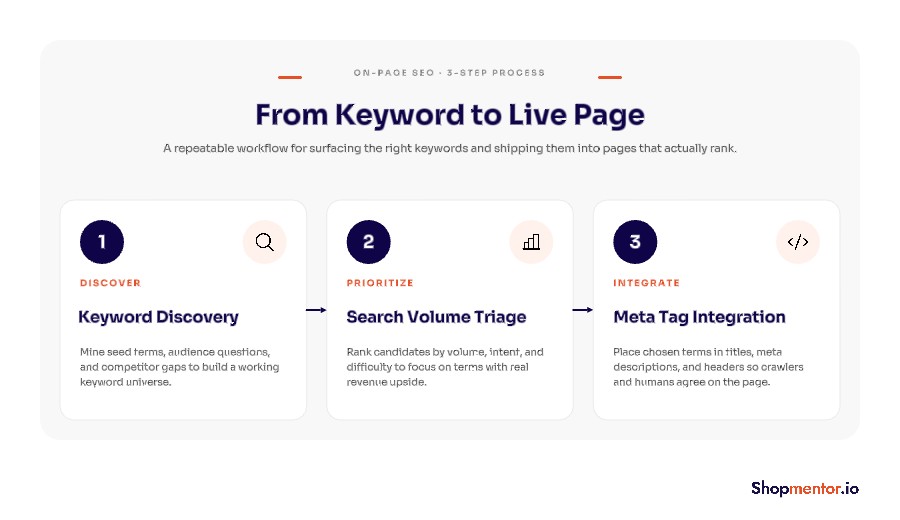
As you can see, discovering issues is just the first step. The real work is in turning those discoveries into on-page and off-page optimizations.
Expert Tip: Before you touch a single listing, create a master spreadsheet with your one, true NAP. Use this exact formatting every single time you build a new profile or fix an old one. This "source of truth" document is your best defense against future inconsistencies.
Building Authority with Local Link Building
After you've cleaned up your citations, it's time to build local authority with link building. Unlike citations, which are just mentions, local links are actual, clickable hyperlinks from other local websites pointing to yours.
These links are incredibly powerful signals because they act as genuine votes of confidence from your own community.
When you get a link from the local Chamber of Commerce, a neighborhood blog, or a complementary business down the street, it tells Google that you are a recognized and respected part of the local fabric.
Here are a few practical ways to earn these valuable local links:
- Sponsor a local charity event or youth sports team. This almost always earns you a link from their website.
- Partner with non-competing local businesses. A bakery could co-host a morning tasting event with a coffee shop, and both would link to each other to promote it.
- Host a workshop or community class. Offer up your space or expertise and get featured on community calendars and event sites.
- Join local business associations. Groups like the Chamber of Commerce or a downtown business improvement district nearly always have member directories with links.
Earning these links is less about technical outreach and more about genuine community engagement. When you embed your business in the local community, you naturally attract the kind of authoritative links that Google loves to see, cementing your status as a trusted local leader.
Turning Your Website into a Local Powerhouse
Once you’ve polished your Google Business Profile and tidied up your citations, it’s time to bring the local SEO audit home—to your website. While those off-page signals are great for building your reputation around the web, your on-page elements need to shout your local relevance from the rooftops. This is where you draw a direct line between what you do and where you do it.

So many businesses fall into the trap of using generic, broad keywords. I see it all the time. A contractor might optimize their homepage for "HVAC Services," but real customers don't search like that. Their searches are urgent and specific to their location, like "Emergency HVAC in Brooklyn" or "AC repair near downtown." Your website's SEO has to reflect how people actually look for you.
Weave Local Keywords into Your On-Page SEO
The first place to look in your on-page audit is your title tags, meta descriptions, and page headers. These are the low-hanging fruit—the high-impact spots that tell Google exactly what a page is about and, crucially, where it’s relevant.
Your mission is to blend location-specific keywords into these areas without sounding like a robot. It's a subtle but powerful shift.
- Generic Title Tag: "Affordable Plumbing Services | Joe's Plumbing"
- Locally Optimized Title Tag: "Affordable Plumbing in Scottsdale, AZ | Joe's Plumbing"
See the difference? That simple addition of "Scottsdale, AZ" makes a world of difference. It instantly qualifies your business for local searches and signals to both users and search engines that you’re the right plumber for that area. Apply this same thinking to your H1 and H2 headings across your site.
The Power of Dedicated Location Pages
If your business has more than one physical location, creating unique pages for each one is absolutely non-negotiable.
I once worked with a dental practice that had three clinics in different parts of the city. Their original site just had one "Contact Us" page listing all three addresses. Unsurprisingly, they were invisible in local searches for two of their three locations.
We fixed this by building out separate, dedicated pages for each clinic. Each new page featured:
- The unique NAP (Name, Address, Phone number) for that specific office.
- An embedded Google Map pointing to that exact address.
- Hyper-local content, like testimonials from patients in that neighborhood and photos of the local team.
- Optimized title tags and headers, such as "Family Dentist in Northwood" or "Cosmetic Dentistry in Lakeview."
The result? Within six months, all three locations were ranking at the top of the map pack in their respective neighborhoods. This strategy works because it sends clear, powerful signals for each service area, eliminating any confusion for Google.
Key Insight: Don't make Google guess where you operate. If you serve multiple distinct areas, create a distinct digital footprint for each one on your website. This is one of the most effective SEO techniques for multi-location businesses.
Speaking Google’s Language with Schema Markup
Now for a more technical—but incredibly impactful—part of your on-page audit: checking for LocalBusiness schema markup.
Think of schema as a specialized vocabulary you use to talk directly to search engines. It’s a snippet of code on your site that explicitly defines your business information in a format algorithms can instantly understand.
By implementing LocalBusiness schema, you can spoon-feed Google critical details, including:
- Your exact business category (e.g.,
Dentist,Restaurant,Plumber). - Your hours of operation.
- Payment types you accept.
- Your price range.
- Your precise geo-coordinates (latitude and longitude).
This structured data leaves no room for error. It confirms the NAP on your website, reinforces your service area, and can even help you earn rich snippets in search results. Those are the eye-catching extras that make your listing stand out from competitors who skipped this step.
While you can get deep in the weeds with schema, you can also learn more about other effective SEO techniques in our comprehensive guide to build a more complete strategy.
Analyzing Your Local Competitors
Alright, time to roll up our sleeves and figure out what the competition is up to. You can’t expect to win in local search if you’re flying blind. This part of the local SEO audit is all about shifting your focus from your own website and profiles to the businesses fighting for the same local customers.
The whole point here is to build a clear picture of the top 3-5 competitors who consistently dominate the Google Map Pack for your most valuable search terms.
This isn't about copying them. It's about strategic recon. You're hunting for patterns, figuring out what they do well, and—most importantly—finding where they're dropping the ball. The gaps in their strategy are where your biggest opportunities are hiding.
Identifying Your True Digital Rivals
First things first, you need to know who you're really competing with online. Sometimes, it’s not the business right across the street. Your actual competitors are the ones showing up for the keywords your customers are typing into Google.
To find them, open an incognito browser window (this prevents your search history from influencing the results) and start searching. If you run a hair salon in Austin, you’d search for things like "haircut austin," "balayage downtown austin," and "best hair colorist south congress."
Jot down the names of the businesses that consistently pop up in the top 3-5 spots—both in the local map pack and the regular organic results. These are your digital rivals.
Deconstructing Competitor GBP Strategies
Think of your competitors' Google Business Profiles as a treasure trove of intel. Go through their profiles with a fine-tooth comb and look for clues about what they’re prioritizing.
- Business Categories: What primary and secondary categories have they chosen? They might be tapping into a niche category you’ve completely overlooked that’s bringing in a ton of traffic.
- Business Description: How are they weaving in keywords about their services and location? Is the copy compelling and written for a customer, not just for Google?
- Google Posts: Are they actually using Google Posts? If a competitor is neglecting this feature, they're basically handing you a free win. I once worked with a small retail shop that saw a huge opportunity here—their top rival completely ignored Posts, which let my client dominate the local feed with their new arrivals and promos.
- Q&A Section: Look to see if they’ve pre-loaded their Q&A with common questions. It’s a smart move that lets them control the conversation and handle potential customer objections before they even come up.
Review Velocity and Citation Health
Next, let's look at their reputation and digital footprint. A key metric to watch is review velocity—how quickly are they getting new reviews? A steady trickle of recent, positive reviews is a huge ranking signal. If your main competitor is pulling in 10 new reviews a month and you’re only getting one, you know exactly what you need to work on.
Showing up in the Google Map Pack is a game-changer. It's prime real estate where roughly 42% of users click. While Google’s algorithm is complex, reviews are a major piece of the puzzle; in fact, 90% of marketers agree that customer reviews have a direct impact on rankings. You can discover more insights about local SEO factors on DigitalSilk.com to see just how critical this is.
Key Takeaway: The objective isn't just to have reviews. It's to build a consistent, repeatable process for generating them. A high review velocity tells Google that your business is active, popular, and relevant right now.
At the same time, fire up a citation analysis tool to get a snapshot of their online directory listings. Look for directories where they’re listed but you aren't. This can help you uncover valuable, industry-specific directories you might have missed, giving you a simple roadmap for building up your own citation profile.
By digging into what’s working for your competitors, you can reverse-engineer their success and find the openings they've left for you to exploit. To build on this, you can also explore our guide on other effective SEO techniques to round out your overall strategy.
Common Questions About Local SEO Audits
Even with a detailed guide, a few questions always seem to pop up during a real-world local SEO audit. I've been there. Let's tackle some of the most common ones I hear from business owners so you can move forward with confidence and sidestep those frustrating little hurdles.

How Often Should I Perform a Local SEO Audit?
Consistency is crucial, but you don't need to do a massive, deep-dive audit every month. That would be overkill.
For most businesses, a comprehensive, top-to-bottom audit is perfect to do annually. This gives you a fantastic high-level picture of what's working and helps you map out your strategy for the year ahead.
But a year is a long time to wait. To stay on top of things, I strongly recommend running smaller "health checks" every quarterly. This doesn't have to be a huge project. Just focus on your most critical assets:
- Google Business Profile: Pop in to check for accuracy, look for any new features Google has rolled out, and make sure no unwanted user edits have slipped through.
- Reviews: Glance at your recent reviews and your team's response rates.
- Core Citations: Run a quick scan on your most important directory listings to ensure your business info is still spot-on.
This rhythm helps you catch and fix problems before they have a chance to damage your rankings.
What Is the Difference Between a Citation and a Backlink?
This is a great question, and it's a point of confusion for so many people. They are often mentioned together, but they play very different roles in your local SEO.
A citation is simply a mention of your business's Name, Address, and Phone number (NAP). You'll typically find these in business directories like Yelp or industry-specific sites. A local backlink is a clickable link from another website—like a local blogger, a community event page, or the Chamber of Commerce—that directs traffic to your site.
Here's an easy way to think about it: A citation proves your business exists where you claim it does. It's a foundational data point. A backlink, especially from a respected local source, acts as a vote of confidence. It tells Google that your business is a legitimate, trusted part of the local community.
While both are important, those quality backlinks carry significantly more weight when it comes to boosting your website's authority.
Will Fixing My Citations Guarantee a Top Ranking?
I wish I could say yes, but the honest answer is no. While cleaning up inconsistent citations is an absolutely critical, foundational task in any local audit, it's not a magic wand.
Unfortunately, you can't just fix your NAP data and expect to rocket to the #1 spot in the Google Map Pack. Local SEO is a puzzle, and you need all the pieces to fit together.
Achieving and holding onto those top rankings is a result of several factors working in harmony:
- Consistent Citations: The clean, solid foundation we just talked about.
- A Perfectly Optimized GBP: Your digital storefront has to be flawless.
- A Healthy Flow of Positive Reviews: This is non-negotiable social proof and a direct ranking signal.
- Strong On-Page SEO: Your website itself must clearly signal its local relevance.
- Quality Local Backlinks: Those authoritative "votes of confidence" from other local sites.
When you get all these elements aligned, your odds of dominating the local pack go up dramatically. If you neglect any one of them, it can hold you back, no matter how perfect the others are.
Ready to take the guesswork out of your local SEO and see real results? Shopmentor.io integrates all your key data sources into one simple dashboard, providing personalized, actionable recommendations to boost your visibility. Stop wondering what to do next and start outshining the competition. Start your free trial of Shopmentor.io today!