%20(1).avif)
.jpg)
Think of local directory listings as the modern Yellow Pages, but supercharged. They are essential digital signposts scattered across the internet, each one pointing potential customers right to your front door. In the first 100 words of this guide, you'll see these aren't just static online business cards; they're dynamic tools that connect you with people in your area who are actively looking for the exact services you offer.
Why Local Directory Listings Are a Cornerstone of Modern Marketing

Remember when getting into the phone book was all it took? Those days are long gone. Today, your visibility hinges on being present—and accurate—across dozens of online platforms. Local directory listings are the absolute foundation of any solid local marketing strategy, often serving as the very first impression a customer has of your business.
These listings have moved way beyond simple digital address books. They've evolved into interactive hubs that directly answer the explosion of "near me" searches. That shift in how people search is a game-changer for any business with a physical location.
Meeting Customers Where They Search
The path to a purchase almost always starts with a search. Someone needs a great cup of coffee, a reliable plumber, or a new pair of shoes, and the first thing they do is grab their phone.
This is where your local directory listings shine. They make sure your business pops up in those critical, high-intent moments.
- Boosts Your Visibility: When your business info is consistent across multiple directories, it sends a strong signal to search engines like Google that you're a legitimate, active business. This dramatically improves your odds of showing up in the coveted "local pack" map results.
- Builds Instant Trust: An accurate, detailed listing filled with positive reviews is powerful social proof. It reassures potential customers that you're a credible, professional business they can count on.
- Drives Real-World Action: Listings give customers everything they need to take the next step. With a single tap, they can call you, click through to your website, or get directions straight to your location.
Local directory listings aren't just about getting found—they're about getting chosen. They provide the critical details like hours, services, and location that convert a curious searcher into a paying customer.
The Data Behind Local Intent
The move toward local search isn't just a hunch; the numbers are staggering. Local directory listings are a critical piece of local SEO because they cater precisely to how people find businesses now. Data shows that a massive 46% of all Google searches have local intent. Even more telling, "near me" searches have grown 150% faster than other types of searches in recent years.
What does this mean for you? Nearly half the people using Google are looking for something nearby. If your listings are missing or incorrect, you're essentially invisible to a huge chunk of your target market.
To see how these listings fit into the bigger picture, check out a comprehensive guide to Local SEO. It helps frame how this one tactic is part of a larger, more powerful strategy for attracting local customers. By making your directory presence a priority, you're building a strong foundation for sustainable growth.
The Anatomy of a Perfect Listing
A great local directory listing is so much more than just your business name and address. Think of it as a detailed, persuasive profile, carefully crafted to grab the attention of local customers and turn them into paying clients. To build one that actually works, you need to sweat the small stuff—every single field matters.
Your listing is your digital storefront. You wouldn't leave your physical shop messy or with a broken sign, right? The same principle applies here. Every piece of information paints a picture for potential customers, so let's make it a good one.
Getting the Foundation Right: Your NAP Data
The absolute bedrock of any local listing is what we call NAP data: Name, Address, and Phone number. This information has to be exactly the same everywhere it shows up online. I'm talking character-for-character consistent.
Even a tiny difference, like using "St." on one site and "Street" on another, can confuse search engines. That confusion makes them trust you less. When Google sees your identical NAP across dozens of credible directories, it's a huge confidence signal that you're a legitimate, established business. That trust directly translates into better local search rankings.
This is where you have to start. Get your core information locked down and consistent before you do anything else.
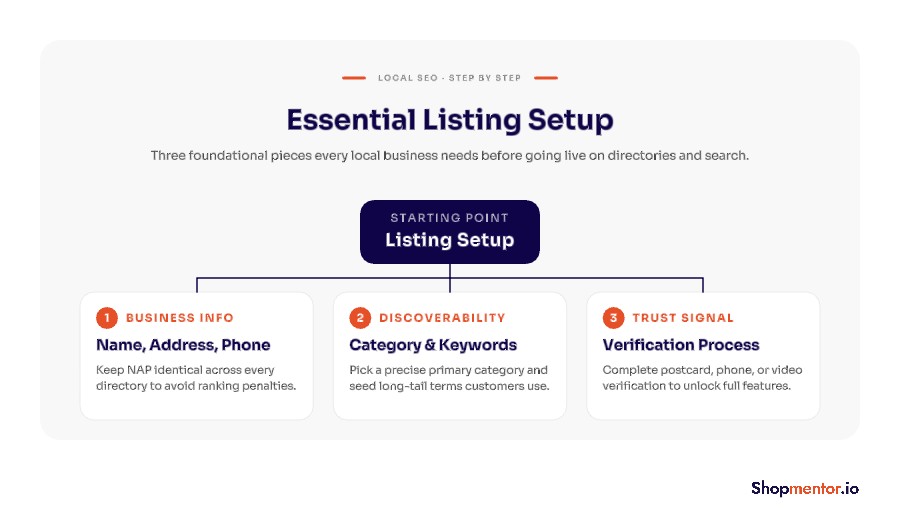
As you can see, it all begins with accurate info, smart categorization, and getting that all-important verification checkmark.
Building Out the Essentials
With your NAP set in stone, it's time to add the details that turn a basic listing into a powerhouse resource for customers.
- Business Categories: Don't be vague. If you run a pizzeria, don't just put "Restaurant." Choose "Pizzeria" or "Italian Restaurant." Most platforms let you pick a primary category and then add a few secondary ones, so use them to cover everything you offer.
- Hours of Operation: Nothing frustrates a customer more than showing up to a closed business. Keep your hours perfectly up-to-date, especially for holidays. One study found that 50% of people lose trust in a business after finding incorrect info online.
- Website Link: This seems obvious, but you’d be surprised how many businesses forget it. Always include a direct link to your website. It's the most direct path for a customer to learn more or make a purchase.
Keeping all this data straight across countless sites is a job in itself. Consistent business listing management is key to making sure every customer interaction is a positive one.
To get this right, it helps to break down a listing into its core parts. Each piece has a specific job to do and a different impact on your visibility.
Anatomy of a Perfect Local Directory Listing
Here's a look at the key components of a listing, why they matter for SEO, and how to get them right.
.png)
Mastering these elements is the secret to creating a listing that not only gets found but also actively persuades customers to walk through your door.
Bringing Your Listing to Life
Okay, the foundational data is in. Now for the fun part: adding the rich content that makes your business jump off the screen. This is your chance to show, not just tell, customers why you're the best choice.
An optimized listing doesn't exist in a vacuum; it’s a crucial part of your broader Search Engine Optimization (SEO) strategies. And visuals are a massive part of that. For instance, did you know that listings with photos get 35% more clicks to their websites? That's a huge advantage.
- Show Off with Photos: Post high-quality pictures of your storefront (inside and out), your products in action, and your happy team. Help people visualize the experience.
- Write a Great Description: Tell your story. What makes you different? Use a conversational tone but be sure to weave in a few keywords that people might use to find you.
- Highlight Special Features: Don't forget the little things! Mention attributes like "free Wi-Fi," "wheelchair accessible," or "curbside pickup." These can be the deciding factor for a customer.
When you take the time to fill out every single section, you’re not just feeding an algorithm. You’re building a trustworthy, comprehensive, and compelling profile that brings real customers to your business.
How to Choose the Right Directories for Local Listings

With hundreds of local directory listings out there, it’s easy to feel like you're drowning in options. The temptation is to sign up for everything, but that's a classic mistake. Spreading yourself too thin just wastes time and makes your efforts less effective. The smarter play is to focus your energy on the directories that will actually move the needle for your business.
The truth is, not all platforms are created equal. Some are massive data hubs that act as the source of truth for countless other sites. Others are laser-focused on a specific industry. Getting a handle on these differences is the key to building a powerful and relevant citation profile, saving you the headache of managing dozens of low-impact listings.
The Three Tiers of Local Directories
I find it helpful to think of the directory world as a pyramid. At the very top, you have the heavy hitters that are non-negotiable for almost any business. As you move down, the directories get more specialized and targeted.
- Major Data Aggregators: These are the big data warehouses of the internet. Think of companies like Foursquare and Data Axle. They collect, clean up, and validate business information, then feed it to a huge network of other websites and apps. Getting your info right with them is critical because an error here can multiply and spread across the web like a virus.
- Broad Consumer Platforms: This is the tier everyone knows. We're talking about the household names where customers are actively looking for businesses and leaving reviews: Google Business Profile, Yelp, Apple Maps, and Facebook. Being present and active here is essential because these platforms have massive audiences and directly shape what customers decide.
- Niche and Hyper-Local Directories: This is where you can really gain an edge. These are the directories that cater to a specific industry (like TripAdvisor for travel or Avvo for lawyers) or a specific geographic area, like your local chamber of commerce site or a popular neighborhood blog.
Creating Your Priority List
Remember, the goal isn't to be on every directory imaginable. It's about being on the right ones. A strategic approach means you put your time where it counts the most. You need to start by prioritizing the platforms that give you the biggest bang for your buck.
A focused directory strategy is about quality over quantity. Securing five highly relevant, authoritative listings is far more valuable than having 50 listings on obscure, low-traffic websites.
To build your hit list, you’ll want to do a bit of research focused on three key areas. This approach helps you pinpoint the platforms your customers are already using and where your presence will make the biggest splash.
Researching Your Best Opportunities
First things first, look at each potential directory through the lens of authority and relevance. A high-authority site like Yelp simply carries more weight with search engines than a brand-new, unknown directory. Check a site’s reputation and see if it already ranks well for terms related to your industry.
Next, put yourself in your customer’s shoes. Where do they hang out online? A trendy restaurant might see a ton of business from Instagram and Yelp, while a B2B contractor could get more qualified leads from a specialized industry portal. You have to meet your customers where they are.
Finally, do some old-fashioned competitive snooping. Search for your top three local competitors and see where they consistently show up. You can use tools like Moz Local or BrightLocal to speed this up, but even a simple Google search can reveal their strategy. If your main rivals are all on a particular niche site, that’s a clear signal you need to be there, too. This methodical approach ensures your local directory listings aren't just out there, but are strategically placed to grab the most attention.
Claiming and Managing Your Listings

So, you've figured out which directories matter for your business. Now comes the real work: taking control of your local directory listings. This is where you transform a random collection of online mentions into a powerful, unified marketing tool.
It’s all about taking ownership of your online identity. You'll correct misinformation, fill in the blanks, and make sure every potential customer sees accurate, compelling information about what you do. Think of it like tidying up your storefront before the grand opening—you want everything to be perfect for your guests.
Start with a Citation Audit
Before you can start fixing things, you have to know what you're up against. This is where a citation audit comes in. It's simply a thorough search across the web for every mention of your business's core information: its name, address, and phone number (NAP).
You'll be surprised what you find. Many listings are created automatically by data aggregators, meaning you might have a presence on sites you've never even heard of.
During your audit, you'll generally uncover three kinds of listings:
- Correct Listings: These are accurate and just need you to claim them so you can keep them that way.
- Incorrect Listings: These have the wrong address, an old phone number, or outdated hours. These are your top priority, as they actively confuse customers and search engines.
- Duplicate Listings: This is when a single platform has multiple profiles for your one business location. These need to be merged or removed to avoid splitting your SEO authority.
You can get started with some basic Google searches, like "[Your Business Name] + [Your City]" or just your business phone number. For a deeper dive, however, tools from companies like Shopmentor.io can automate the search and save you a ton of time.
The Process of Claiming and Verification
Once you have a list of all your online citations, it's time to claim them. This is the process where you officially prove you're the business owner, which grants you the keys to edit and manage the profile.
The exact steps change from site to site, but for the big players like Google Business Profile, the process is pretty standard:
- Find Your Listing: Search the directory and locate your business profile.
- Initiate the Claim: Click the button that says something like "Claim this business" or "Own this business?".
- Verify Your Ownership: This is the crucial part. The directory needs to confirm you are who you say you are. They usually do this by mailing a postcard with a PIN to your physical address, making an automated call to your business phone number, or sending an email.
Completing the verification process is non-negotiable. An unverified listing is like an unclaimed piece of digital real estate—anyone can influence it, and it lacks the badge of trust that both customers and search engines look for.
Manual Management vs. Automated Software
With your most important listings claimed, you've got a decision to make. How will you keep all this information accurate over time? You can go it alone and manage each listing by hand, or you can use a software tool to do the heavy lifting.
Manual Management:
- Pros: It’s free (if you don't count your own time) and you have direct, hands-on control.
- Cons: It's incredibly time-consuming, especially if you're on more than a few directories. It's also shockingly easy to make a typo and create a new inconsistency.
Automated Software:
- Pros: Enter your business info once, and the software syncs it across dozens of directories automatically. This ensures consistency and saves a massive amount of time.
- Cons: These services require a subscription fee.
Honestly, for most small businesses, the accuracy and time saved by using a service easily justifies the cost. It lets you get back to running your business, knowing your local directory listings are consistently working for you.
Turning Listings into Lead-Generating Machines
A fully optimized local directory listing is so much more than a digital business card. It's a proactive tool that turns casual searchers into paying customers. Once you've claimed your profiles and cleaned up the basic information, it's time to start thinking about them as powerful conversion tools. This means using every feature at your disposal to give customers a dead-simple path to book, call, or buy from you.
Think about it this way: a basic listing is like a sign on a closed door. An optimized, conversion-focused listing is an open door with a welcome mat, clear signage, and someone ready to help the moment a customer walks in. It closes the gap between someone finding you and them taking action.
Talk to Your Audience
Modern directories aren't just static pages anymore; they're dynamic spots for real interaction. Features like Google Posts and Q&A sections are prime real estate for connecting directly with people who are already looking for what you sell. Using these tools tells both customers and search engines that you're an active, responsive business.
- Google Posts: Think of these as mini-billboards right on your Google Business Profile. You can share updates, flash sales, new products, or upcoming events. A good post can grab a searcher's attention with a compelling image and a great offer.
- Q&A Sections: Potential customers ask questions directly on your listing all the time. Answering them quickly and clearly doesn't just help that one person—it builds a public FAQ that helps everyone else who comes along.
This kind of proactive engagement shows you're paying attention and you care about your customers, which builds trust before they've even clicked through to your website.
Build Trust by Managing Your Reviews
In the world of local search, reviews are the ultimate form of social proof. A steady stream of positive feedback is often the one thing that convinces a customer to choose you over the shop down the street. But just getting reviews isn't the whole story. You have to actively manage them.
Responding to every single review—good or bad—shows that you value what your customers have to say and that you're committed to giving them a great experience. A thoughtful reply to a negative review can often turn a bad situation around and shows everyone else that you take ownership.
Make it easy for your happy customers to leave feedback. This constant flow of fresh, positive reviews is a huge signal to search engines and a massive driver of new business. Businesses that stay on top of their online reputation build the kind of credibility that directly influences buying decisions.
Make it Easy for People to Buy
The final piece of the puzzle is to make it ridiculously easy for people to take the next step. Don't make them search for your phone number or dig through your site to find a booking link. Instead, use the built-in features on directories to give them a direct path to what they need.
Platforms like Google Business Profile let you add powerful, direct action links:
- Book an Appointment: Perfect for salons, mechanics, or clinics.
- Request a Quote: A must-have for contractors and custom service providers.
- View Menu/Products: Essential for restaurants and retail shops.
- Place an Order: Great for any business offering delivery or pickup.
These features remove all the friction. When a potential customer can go from a search to a booking in two clicks, you're going to win more business. Local directories have a huge impact on how you get new customers, especially as the line between online and in-person shopping blurs.
Accurate and complete listings are vital for getting seen online and driving people to your door. In fact, studies show that up to 70% of mobile searchers will call a business right from the search results. To get the most out of this, improving your Google Maps ranking is a critical next step. By adding these powerful calls-to-action, you’re not just providing info—you’re actively driving sales and turning your listing into a true performance asset.
Common Mistakes in Directory Management
Getting your business listed on local directories is a huge step, but the real work is in managing those listings correctly. A few seemingly small mistakes can completely sabotage your efforts, making your business invisible to the very customers you're trying to attract. These aren't just minor slip-ups; they actively confuse search engines and can send potential customers straight to your competition.
Think of your listings as your business's digital handshake. If you give a different name or phone number every time you shake someone's hand, you'll quickly lose trust. Keeping that handshake firm and consistent is key to building a solid local reputation.
Overlooking Inconsistent NAP Data
The single most damaging mistake is having inconsistent NAP (Name, Address, Phone Number) information scattered across the web. It seems trivial, but variations like "St." versus "Street" or "(555)" versus "555" create major headaches for search engines.
When Google sees conflicting details, it gets confused and loses confidence in your business's data. This uncertainty can tank your local search rankings. Your NAP needs to be an exact match everywhere, right down to the last comma. It's the bedrock of a trustworthy local presence.
The rule is simple: one business, one name, one address, one phone number. Every variation you allow to exist online is a crack in your digital foundation, weakening your visibility and confusing your customers.
Ignoring Duplicate Listings
Duplicate listings are another silent killer of local SEO. This happens when multiple profiles for the same business location pop up on a single directory, often created by automated data sources without you even knowing.
Each of these rogue profiles can start collecting its own reviews and data, splintering your online authority. Instead of having one strong, unified presence, you end up with several weak ones fighting for attention. You have to be proactive about hunting down these duplicates and either merging or removing them to consolidate your strength into one authoritative profile.
Neglecting Customer Reviews
Leaving customer reviews unanswered—good or bad—is like letting the phone ring off the hook. When someone takes the time to share their experience, they're looking for acknowledgment. Ignoring them signals that you don't care, which is a major red flag for potential new customers.
On the other hand, responding quickly and professionally to all reviews builds powerful social proof. It shows everyone watching that you stand behind your business and value your customers. This simple act of engagement can make all the difference.
Staying on top of your listings is absolutely essential for growth. The data doesn't lie: when businesses get their information onto 10 or more directories, they can see their local search visibility jump by as much as 91%. Even more compelling, 56% of actions on Google Business Profile listings are website visits. Each listing is a direct path for turning a searcher into a customer. You can see more data on how active listing management drives customer engagement on llcbuddy.com.
Got Questions? We've Got Answers.
Still wondering about a few things? Let's clear up some of the most common questions business owners have about local directory listings.
What’s the Price Tag on These Listings?
Here’s the good news: many of the most powerful local directories won’t cost you a dime. Getting set up on heavy-hitters like Google Business Profile, Yelp, and Apple Maps is completely free for a standard profile.
Now, some specialized, industry-specific directories might charge a subscription. You'll also see optional paid upgrades on the free platforms, like advertising or enhanced profile features. But honestly, you can get fantastic results just by using the free tools and managing them well.
How Long Until I Actually See Results?
Patience is key here. While you might see some quick wins in a few weeks just by fixing major errors (like a wrong phone number), the real SEO magic happens over time.
Think of it like building a solid reputation in your neighborhood. It doesn't happen overnight. By consistently updating your info, gathering new reviews, and keeping everything accurate, you build trust. Over three to six months, that effort compounds, and search engines start rewarding that trust with much better visibility.
I Already Have a Website, Do I Still Need These?
Yes, one hundred percent. Think of your website as your main office, but your directory listings are the billboards, street signs, and front-door posters all over town. They catch people on the platforms they’re already on, like Google Maps or Yelp, often long before they’d think to search for your website directly.
These listings are what get you seen in those critical "near me" searches and on map packs, which are a huge source of ready-to-buy customers. In fact, one study found that 56% of actions on a Google Business Profile listing are website visits. They don't replace your site—they act as the most important gateways leading customers right to it.
Ready to take control of your online presence and turn local searchers into loyal customers? Shopmentor.io provides the tools you need to manage your listings, track performance, and outshine the competition. Start your free trial today and see the difference.